History & Heritage
The church and slavery
This church holds monuments and graves connected with slavery and with empire. This page sets out who these people were and what the records show, as plainly as we can.
Why this page exists
A church is not a museum. People come here to pray, to be married and to bury their dead, and they do it surrounded by memorials that were put up by somebody. Those memorials say what the people who paid for them wanted said.
The Church of England’s guidance on contested heritage is clear that leaving such objects unexplained is itself a statement: for them “to remain in place with no discussion or interpretation could be taken to imply that the oppression and disenfranchisement they evoke for many in affected communities is socially and theologically acceptable to the Church”.[1] It is equally clear that nobody should wait to be told there is a problem before looking into it.
So this is not a response to a complaint. Nothing here is being moved or taken down. What follows is simply what we know, with the sources, so that anybody who wants to check it can.
Some of the families named here still have descendants living, and some are known to us. Nothing on this page is addressed to them. Responsibility for what was done in the eighteenth and nineteenth centuries does not pass down a family, and no one alive is being asked to answer for an ancestor. What this page is for is the church’s own account of what it holds and how it came to hold it.
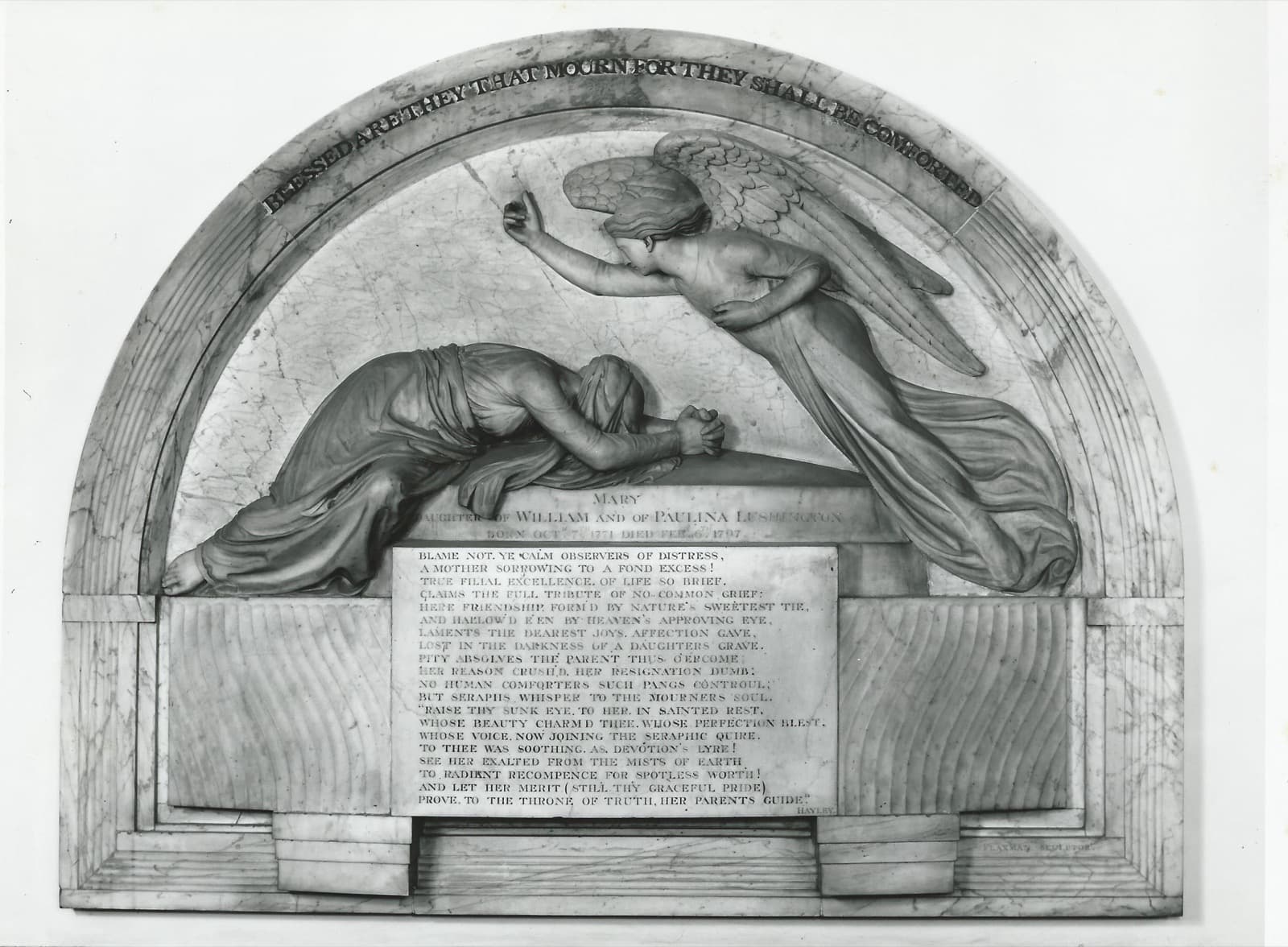
William Lushington, and the monument on the nave wall
On the nave wall is a monument to a woman who died at twenty-five, and it is among the finest things in the building. Mary Lushington was born in Calcutta in 1771 and died in February 1797. Her mother Paulina commissioned John Flaxman, one of the great sculptors of the age, to carve the monument, and the poet William Hayley to write the verse on it. It is signed FLAXMAN. SCULPTOR. and dated 1798, and it carries a line from the Beatitudes: Blessed are they that mourn, for they shall be comforted.[5]
Her father was William Lushington (1747–1823), and he is buried in this churchyard.[3] He was the fourth son of a Sussex vicar. He went out to Bengal for the East India Company as a boy of sixteen, married an heiress in Calcutta, and came home rich.[2]
He was then, in order:
- Agent for Grenada, from May 1795 until 1815 — the paid London representative of the colony’s planters. He held the post for twenty years.
- Member of Parliament for London, 1795 to 1802, and Alderman for the Billingsgate ward.
- A director of the West India Dock Company, 1803 to 1808.
On 4 May 1795 he presented a petition to the Commons on behalf of the West Indian interest, and spoke and voted for it the following month. The History of Parliament records, drily, that he “damaged his fortune by over-ambitious investment in West Indian trade”.[2]
The Church Record, compiled by volunteers who catalogued every object in this building, describes him as having had “business interests in the West Indies”.[5] Those interests are the ones listed above. For twenty years, the work was to represent the owners of enslaved people in London and in the British Parliament.
Two hundred and eighteen people
When slavery was abolished in the British colonies, Parliament voted £20 million to compensate the owners for the loss of their property. The people who had been enslaved received nothing.
Two of William Lushington’s daughters — sisters of the Mary whose monument is on our nave wall — were among those paid.
- Mount Nesbitt, Grenada
- Awarded 9 November 1835 to “the Misses C. and A. Lushington, of Kent in England”.
- 124people enslaved — £3,201 2s 4d paid
- Union Estate, Trinidad
- Awarded 13 June 1836 to Charlotte Lushington.
- 94people enslaved — £4,321 9s 9d paid
The compensation is recorded to the shilling. The names of the people it was paid for were written down too.
Sources: UCL Legacies of British Slavery; Slave Compensation Commission papers T71/880 and T71/519.[3, 4]
Their names still exist
The Trinidad record carries a note: the enslaved people at Union Estate “were registered by James Sargent, attorney to Charlotte Lushington”.[4] That register survives, at The National Archives.
Trinidad’s slave registers are the most detailed in the British empire. For each person they record a name, a surname, an occupation, an age, a stature, a country of origin and family relations.[8]
Which means that for ninety-four people held on an estate owned by a family from this parish, there is a document giving their names, their ages, where in Africa many of them were taken from, and who they were related to. We intend to find those names and publish them here. This church has a board listing its vicars back to about the year 1200, and a monument naming a woman who died at twenty-five. It can find room for these names too.
Joseph Innes, and what we do not know
In the north gallery, above the doorcase, is a tall memorial with a portrait medallion of a young man in profile. It was made by Sanders Oliver in 1781 and it reads:
To the Memory of JOSEPH INNES, Who, in His 34th Year, Sept. 7th 1779, Fell a Victim, To the Toils of Public Duty; In JAMAICA, Threatened with a French Invasion.
He died in Jamaica in 1779, in some official role, at a moment when the island expected a French attack. What his “public duty” actually was, we have not been able to establish.[5]
Our own parish history records that he was the nephew of William Innes, a West India merchant who lived at Blackheath and was Captain of the Society of Golfers there.[6] We have not been able to confirm that relationship in any independent source, and it should be treated as parish tradition rather than established fact.
William Innes himself is remembered for something else entirely. In 1790 Lemuel Francis Abbott painted him in his captain’s red coat, club over his shoulder; the engraving after it, by Valentine Green, is one of the most reproduced images in the history of golf.[7]
A West India merchant was a London trader in the produce of enslaved labour — overwhelmingly sugar. That much is simply what the term means. Whether William Innes personally owned enslaved people we cannot say: the database that records British slave-owners covers those alive at abolition in 1833, and he was long dead. His absence from it is not evidence of anything.
The National Trust catalogues the picture as “William Innes, Captain of the Blackheath Club, and his Caddie, a Greenwich Hospital pensioner”.[7] The caddie — an old or injured sailor from the naval hospital down the hill — is standing in the painting, carrying the clubs. One man is recorded by name and the other by his occupation. That is the ordinary pattern of the records of the period, and it is much of the reason a page like this one is needed.
Captain Charles Weller
Buried in the churchyard: captain and owner of the Albion in the East India Company’s navy from 1824 to 1826, died 1866 aged 84.[6]
This is a different history from the one above and should not be filed under the same heading. The East India Company traded in cotton, silk, indigo, salt, saltpetre, tea and opium; it came to rule large parts of India, and kept a private army to do it. That is empire, and the harm it did was real, but it is not Atlantic slavery and the two should not be blurred. The Church’s guidance itself distinguishes between degrees of involvement, and being accurate about them is part of taking the subject seriously.[1]
John Edward Gray, who argued the other way
Also buried here: John Edward Gray (1800–1875), Keeper of Zoology at the British Museum for thirty-five years, who built what was then the largest zoological collection in the world and published over a thousand papers. He kept working after a stroke paralysed him in 1870. He also bought several Penny Blacks on the day they went on sale in 1840 intending to keep them, which makes him by common account the first stamp collector there has ever been.
Our parish history records that his interests “were not confined to natural history only, for he took an active part in questions of public importance of his day, such as slave emancipation, prison discipline, abolition of imprisonment for debt, sanitary and municipal organizations, the decimal system, public education”.[6] That account is our own historian’s; we have not yet checked it against an independent authority.
Gray is here because he shows that these questions were live and argued at the time, and not only in hindsight. Emancipation had advocates among the contemporaries of the people commemorated elsewhere in this church, and one of them is buried in the same ground.
What we are doing
Nothing in the building has been moved, altered or removed, and nothing is proposed. Under the Church’s guidance this page is interpretation: the option of explaining what is there rather than changing it.[1]
The guidance offers a choice between stating the facts plainly and expressing repentance. For now we have done the first. Whether this parish should also say something more is a question for the Parochial Church Council, which will consider it, and anything it decides will be added here.
The next piece of work is the ninety-four names in the Trinidad register, and then the hundred and twenty-four in Grenada.
If you have information that corrects or adds to any of this — particularly on Joseph Innes, or on the families of anyone enslaved on these estates — we would be glad to hear from you. Please get in touch.
References
- [1]Contested Heritage in Cathedrals and Churches, Church Buildings Council and Cathedrals Fabric Commission for England, © Archbishops' Council, May 2021.
- [2]The History of Parliament: the House of Commons 1790–1820, ed. R. Thorne (1986), entry for LUSHINGTON, William (1747–1823).
- [3]Legacies of British Slavery database, UCL Centre for the Study of the Legacies of British Slavery, entry for Charlotte Lushington (person 11282).
- [4]Slave Compensation Commission records, The National Archives: T71/880 (Grenada claim 608, Mount Nesbitt) and T71/519 (Trinidad claim 1700, Union Estate).
- [5]The Church Record of St Mary the Virgin, Lewisham: Memorials, items 023 (Mary Lushington) and 043 (Joseph Innes).
- [6]Julian Watson, St Mary's Church Lewisham: History (2004, revised 2017).
- [7]National Trust Collections, NT 541159: engraving by Valentine Green after Lemuel Francis Abbott, 1790.
- [8]The National Archives research guide, 'Enslaved people and slave owners', on series T71 and the colonial slave registers.
Elsewhere on this site
Every person on this page is also on the monuments, described there as objects in a building rather than as histories — the Flaxman that is the finest thing in the church, the memorial with the portrait medallion above the north gallery doorcase, and the churchyard grave of the man who bought the first Penny Blacks ever collected. Both accounts are true and neither is complete on its own, which is the reason this page exists separately rather than as a paragraph over there.
The Georgian building all of this sits inside was paid for by borrowing against the church rate and letting the gallery pews — on the history pages. Those galleries are where the Innes and Petrie monuments hang.
Where this comes from
This parish is fortunate in its historians. Three works stand behind these pages, and none of them is ours.
St Mary's Church Lewisham: History (2004, revised 2017)
Julian Watson
Copyright Julian Watson, used with his permission. The greater part of what is written here comes from this book and from his unpublished research, and any of it that is wrong is our doing rather than his.
The Churchyard of St Mary the Virgin, Lewisham (1992)
Ken White
Copyright Ken White, used with his permission.
The Church Record of St Mary the Virgin, Lewisham
The Arts Society Blackheath and The Arts Society Greenwich, completed by the Church Recording Society, 2021–2024
A catalogue of every object in the building, begun in the incumbency of Canon David Garlick and finished in that of Fr Steve Hall. The descriptions, measurements and attributions of the monuments come from it.
The Parish Church of Saint Mary, Lewisham, Kent (1892)
Leland L. Duncan, F.S.A.
Out of copyright, so this is a citation rather than a licence — but it is the single largest source for the medieval parish, the tower bequests, the churchyard, the vicarage house and the medieval vicars, and its six plates are the earliest images the parish has. Duncan was honorary secretary of the Lewisham Antiquarian Society, which met in the parish church hall, and he was educated at Colfe's — the school one of these vicars founded.
Some of these captions are guesses. Please correct us.
The parish archive runs to well over a thousand photographs, most of them unlabelled. Where a caption here rests on a filename rather than on a document, it says so — but we will have got things wrong that we do not yet know are wrong.
If you recognise a place, a face, a date or an object, we would be very glad to hear from you, and we will change the page and say who told us. Photographs of the church before the 1990s re-ordering, and anything at all of the choir, would be especially welcome.
Text and images are the copyright of their authors unless otherwise stated. If you would like to reproduce anything from these pages, please ask us and we will put you in touch with the right person.