History & Heritage
The ancient parish
For nine hundred years this was the only church for the whole of Lewisham — Blackheath to Sydenham, Brockley to Bellingham. Nineteen parishes were carved out of it in under a century, and the old line still decides who can apply to the parish charities.
Lewisham was given to the abbey of St Peter at Ghent in 918, and the parish that grew up around that grant was enormous. Until the 1830s St Mary’s was the only place of worship in it. One vicar, one church, one set of registers, for an area that now holds a couple of dozen churches and a quarter of a million people.
That is the fact behind almost everything else on these history pages: why the church has galleries, why the bells were rung for the whole district, why a seventeenth-century vicar could found schools and almshouses for what he thought of simply as the parish, and why those charities still use his boundary rather than the council’s.
Somebody’s dear son
The parish is named after a man. Long before any of the rest of this, a Saxon called Leofsunu settled in the valley the Ravensbourne runs through, and the place took his name: Leofshema, the home of Leofsunu. The parish’s own 1916 roll of honour cites the philologist W. W. Skeat for the same reading — a homestead in which dwelt a man of that name — and both agree on what the name itself means.
It means “dear son”. Leofshema became Lievesham, then Lusam, then Lewisham. The middle form is not a reconstruction: King Edgar’s charter of 964 describes the place which the rustics from ancient custom have called Lievesham, and that charter is on the Ghent connection.
What it covered
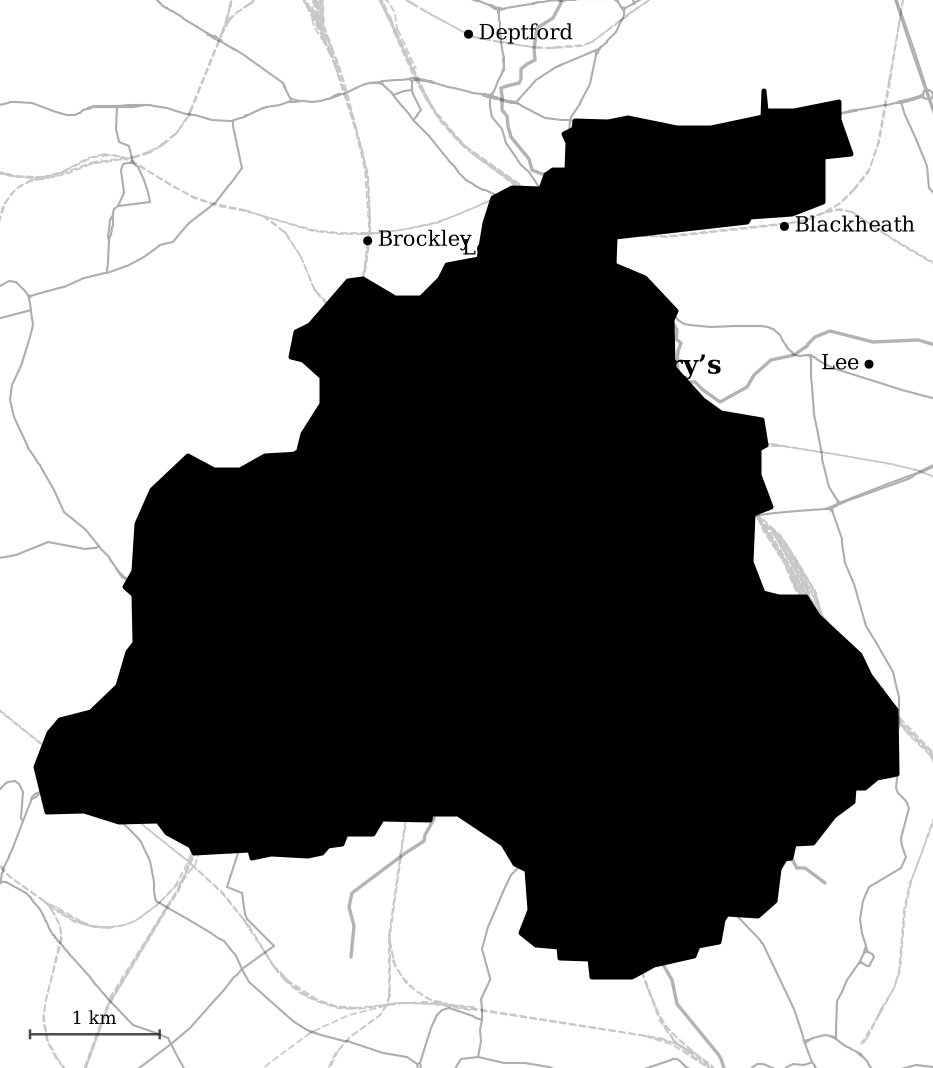
The ancient parish ran from Blackheath in the north to Sydenham in the south, and from Brockley and Honor Oak in the west across to Hither Green in the east. Inside it were Lewisham, Ladywell, Catford, Forest Hill, Brockley, Honor Oak Park, Hither Green, Bell Green, Bellingham, Southend, Upper and Lower Sydenham and a piece of Blackheath.
Just as telling is what was never in it. Deptford was its own ancient parish and so were Lee and Eltham. New Cross, Nunhead, Dulwich, Grove Park, Mottingham, Beckenham and Penge all lay outside. The modern London Borough of Lewisham, created in 1965, is a different shape altogether: it swallowed Deptford and part of Lee and let go of Sydenham’s southern edge.
So a Lewisham address is not by itself an answer. The boundary was drawn long before the streets were, and it cuts across modern postcodes rather than following them.
The twenty parishes carved out of it
Between 1854 and 1938, as the railways arrived and the population rose faster than anywhere near it, the ancient parish was divided again and again. Each of these was once part of St Mary’s.
- 1854St Bartholomew, Sydenham
- 1854Christ Church, Forest Hill
- 1858All Saints, Blackheath
- 1865St Stephen, Lewisham
- 1866Holy Trinity, Sydenham
- 1869St Philip, Sydenham
- 1870St George, Perry Hill
- 1870St Mark, Lewisham
- 1873St Augustine, Honor Oak
- 1879St Michael & All Angels, Sydenham
- 1883The Ascension, Blackheath
- 1887St Paul, Forest Hill
- 1888St Lawrence, Catford
- 1888St Swithun, Hither Green
- 1899St Hilda, Crofton Park
- 1901St Cyprian, Brockley
- 1904St Andrew, Catford
- 1909All Saints, Sydenham
- 1928St John Baptist, Southend
- 1938St Dunstan, Bellingham
Nineteen in eighty-four years. By 1902 the parish was running Sunday schools for over a thousand children with sixty teachers.
What that came to: the count of 1898
In December 1898 a parishioner named Edward H. Oxenham went through the figures and worked out how many people were living in the ancient parish — St Mary’s own districts and every daughter parish together. He counted inhabited houses and reckoned six people to each.
His answer was 16,632 houses and about 99,792 people. One church had served all of that ground, and within living memory of some of the people counted.
St Mary’s own share by then was 2,576 houses and some 15,456 people, in three districts:
- St Mary's (Old Church District)1,329 houses · 7,974 people
- St Cyprian's Mission District1,136 houses · 6,816 people
- Southend Hamlet111 houses · 666 people
Two of those three are on the list above. St Cyprian’s was still a mission district of St Mary’s when Oxenham counted it and became a parish in its own right three years later; Southend Hamlet, with its 111 houses, became St John Baptist in 1928. The count catches them halfway out of the door.
The largest of the daughters by then was St Laurence, Catford, with 13,848 people — nearly as many as St Mary’s three districts put together, on ground that had been fields when the Georgian church was built.
And what was left of it
The parish printed its own map at about the same time. It is the same church and it is not the same parish: a district you could walk across in half an hour, with the names of its own daughters printed around the outside of the line — St Cyprian, St Mark, St Swithun, St Laurence, St Hilda.
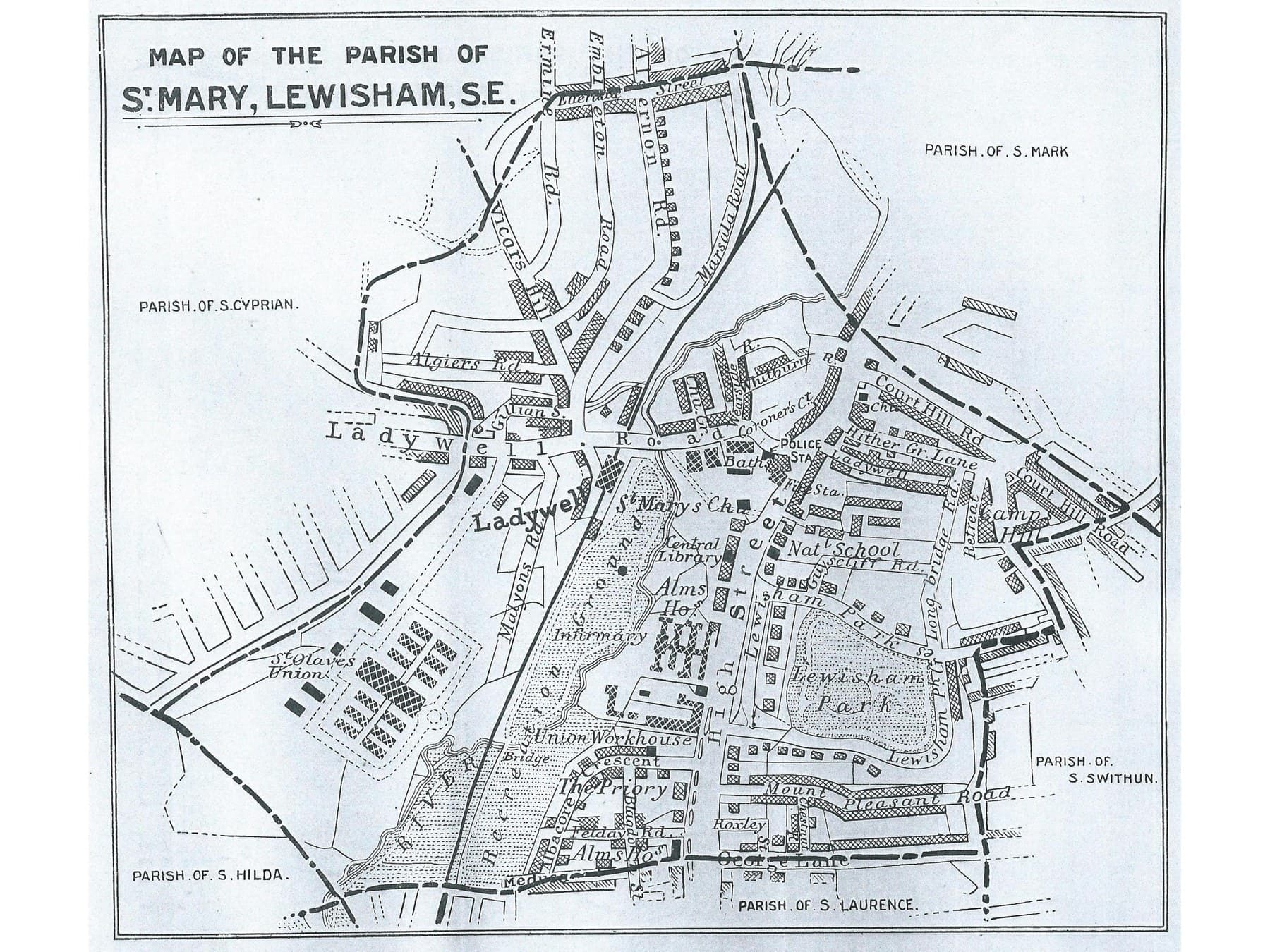
Worth looking at closely for what else is on it. The Union Workhouse and the Infirmary are inside the boundary, and so is St Olave’s Union across the river. So are the almshouses — twice, once beside the church and once down by George Lane. The parish that had stopped being the government was still the parish those institutions stood in.
And what it felt like: 9 February 1902
Four years after Oxenham’s count, the Archbishop of Canterbury came to Lewisham to preach. The parish magazine for March 1902 reported it.
The service was for men only. Over 1,600 men were crowded into the church — every seat taken, and the aisles and the staircases up to the galleries thronged as well. It was reckoned that more than five hundred had to be sent away.
Frederick Temple was eighty and had ten months to live. The magazine describes the crowd outside uncovering their heads as he passed to the church and back to the vicarage, and the old man returning the salutations — especially noticing some children, and stopping to speak to a little child in its father’s arms. The vicar read the prayers, the Bishop of Southwark read the lesson, and the hymns were O God, our help in ages past, Souls of men, why will ye scatter and Sons of labour, accompanied by the band of the 2nd Kent Volunteer Artillery.
And the collection that evening, over £20, was given to the Lewisham Church Extension Association — the body whose business was building more churches. Five hundred men turned away from the door, and the money from the ones who got in went towards somewhere else for them to go.
The parish was also the government
For most of its history this was not only a church. Together with the manor court, St Mary’s was the centre of local government for the whole ancient parish. The vestry — a meeting in the church, of the church — set the rate, appointed officers, maintained the roads, and administered relief of the poor.
That is why the vestry minute books matter so much to the history of Lewisham and not merely to the history of a congregation, and why the 1774 rebuilding needed an Act of Parliament and a rate rather than an appeal. Its administrative duties passed to the Board of Works and then, in 1900, to the Metropolitan Borough of Lewisham.
So the twenty divisions were the second half of a larger change. The parish stopped being the unit of government at about the same time it stopped being a single congregation.
The parish magazine reported the handover before it happened, and did not treat it as a defeat. It began by praising the various Boards and Committees of the Vestry on which so many good and true men give their time and thought to the secular needs of the Parish, and then set out what was coming:
The great change impending in the month of November next will make one Borough of the two parishes of Lewisham and Lee, giving a joint population to the whole Borough of about 123,000, with a rateable value of £752,462, to be called by the name of Lewisham.
The writer then spends a paragraph on where the word mayor comes from, gets it wrong — it is the Latin maior by way of the French maire, not an Anglo-Saxon verb meaning to be strong — and finishes by praying that Lewisham may never be without good men to serve it. Nine hundred years of running the place ended in November 1900, and the body losing the job wrote it up as an improvement and wished its successor well.
Four dioceses, without moving an inch
The parish has changed diocese three times, and the boundary that moved was never this one. Lewisham was in Rochester until 1836; in London from 1836 to 1867; back in Rochester from 1867; and in Southwark from the creation of that diocese in 1905, where it has stayed.
It is a useful thing to carry when reading the building and its possessions. The arms engraved on the parish’s Pugin alms dish are Rochester’s, and the parish acquired it in 1885 — which the sequence above places in the second Rochester period, not the first. Those are on the church silver.
What the church kept doing afterwards
Losing the rate did not end the parish’s part in relieving the poor; it changed how it was paid for. A printed appeal from Bickersteth’s time survives, headed The Parochial Board, asking for subscriptions to five funds. The list is the parish welfare state, itemised, forty years before there was another kind.
- Sick-Diet Kitchen and Poor Fund£60
- Assistant Clergy Fund£50
- Sunday Schools£30
- Provident Societies£20
- General Fund£100
The Provident Societies were four: the Mothers’ Provident Society, the Clothing Club, the Coal Club and the Children’s Shoe Club. People paid in what they could through the year and the fund topped it up, so that there was a coat in October and coal in January. The Sick-Diet Kitchen cooked for the sick and infirm poor.
The General Fund covered shortfalls in the others, emergencies, the printing — and a grant to St Laurence, Catford, which had been carved out of this parish twelve years earlier and was evidently not yet standing on its own. The mother church was still subsidising a daughter.
Subscriptions went to the treasurer at Laburnum Villa, Rushey Green, or to Mr Dunston, the collector, who called. The accounts were published in the parish Year-Book, which you got by asking the verger. The appeal is signed by Samuel Bickersteth as vicar and by George W. J. King as honorary secretary — the same man who was churchwarden here for thirty-one years.
Still connected
The dividing was not the end of the relationship. The Vicar of Lewisham is still patron of three of the churches carved out of this parish — All Saints, Blackheath, St Hilda, Crofton Park and St Swithun, Hither Green — which means a say in who is appointed to lead them.
So the parish that was carved up still helps choose the clergy of three parishes carved out of it, while the Earl of Dartmouth still helps choose ours. Patronage in the Church of England is a long memory of who paid for what, and it has outlasted almost everything else on this page.
Why the old boundary still matters
The charities founded to serve this parish still use its boundary, not the borough’s. If you are applying to the Lewisham Relief in Need Charity for a bed or a cooker, or to the Lewisham Educational Charity for help with a course, whether you qualify turns on whether your address falls inside the ancient parish.
The charities publish a map you can search by postcode, which is the version that governs. Check it before filling anything in. There is more about what the charities give and how to apply on the linked charities page.
Seeing it as it was
Layers of London, run by the Institute of Historical Research, lets you fade historic maps over the modern one. It is the best way to see what the parish actually looked like at different points on this page, and it is free.
- John Rocque’s ten-mile survey, 1746. The earliest detailed map of the area, and the one to look at for Lewisham before the railways: a village strung along the High Street with the church in the middle of open country, and Sydenham and Catford still hamlets. It is ninety years after Abraham Colfe’s death, but nothing much had changed in between.
- The Ordnance Survey of the 1870s. The parish caught mid-division. Blackheath, Sydenham and Forest Hill have their own churches by now; Catford, Hither Green and Bellingham do not yet.
- The bomb damage maps. Why so much of the parish looks post-war, and why Colfe’s almshouses came down in 1958.
We have not copied any of those layers onto this page. They are licensed to Layers of London by the British Library, the London Metropolitan Archives and others, and a photograph of an old map carries its own rights however old the map is. The link is the right way to use them.
Elsewhere on this site
The men who held this parish when it was still whole are on the vicars of Lewisham, and what two of them did with their money is on the schools and the Leathersellers. The parish church itself, and how the building changed as the parish shrank around it, is on the history pages.
Where this comes from
This parish is fortunate in its historians. Three works stand behind these pages, and none of them is ours.
St Mary's Church Lewisham: History (2004, revised 2017)
Julian Watson
Copyright Julian Watson, used with his permission. The greater part of what is written here comes from this book and from his unpublished research, and any of it that is wrong is our doing rather than his.
The Churchyard of St Mary the Virgin, Lewisham (1992)
Ken White
Copyright Ken White, used with his permission.
The Church Record of St Mary the Virgin, Lewisham
The Arts Society Blackheath and The Arts Society Greenwich, completed by the Church Recording Society, 2021–2024
A catalogue of every object in the building, begun in the incumbency of Canon David Garlick and finished in that of Fr Steve Hall. The descriptions, measurements and attributions of the monuments come from it.
The Parish Church of Saint Mary, Lewisham, Kent (1892)
Leland L. Duncan, F.S.A.
Out of copyright, so this is a citation rather than a licence — but it is the single largest source for the medieval parish, the tower bequests, the churchyard, the vicarage house and the medieval vicars, and its six plates are the earliest images the parish has. Duncan was honorary secretary of the Lewisham Antiquarian Society, which met in the parish church hall, and he was educated at Colfe's — the school one of these vicars founded.
Some of these captions are guesses. Please correct us.
The parish archive runs to well over a thousand photographs, most of them unlabelled. Where a caption here rests on a filename rather than on a document, it says so — but we will have got things wrong that we do not yet know are wrong.
If you recognise a place, a face, a date or an object, we would be very glad to hear from you, and we will change the page and say who told us. Photographs of the church before the 1990s re-ordering, and anything at all of the choir, would be especially welcome.
Text and images are the copyright of their authors unless otherwise stated. If you would like to reproduce anything from these pages, please ask us and we will put you in touch with the right person.