History & Heritage
The twentieth century
A bishop moved into the vicarage and turned it into a community. And when Lewisham buried thirteen young people, this church opened its doors and let others lead the worship.
The parish’s twentieth century is the least recorded part of its history and not the least eventful. Everything on this page comes from a folder of scanned papers in the parish’s own keeping — an order of service, a diocesan newsletter, two newspaper cuttings, an appeal brochure and a roll of honour. None of it can be found anywhere online.
The Roll of Honour, 1916
The parish printed a list of everyone serving from St Mary’s, grouped by the organisation they belonged to. It is the best picture the site has of what a parish looked like from the inside before the First World War, because it names the parts: sacristans, the choir, Sunday school teachers, the Church of England Men’s Society, St Mary’s Church Lads’ Brigade, the Guild of King Alfred, the Old Boys of the Sunday schools, and the Boy Scouts.
There are several hundred names. Among the choir is William Whitehead, the organist and choirmaster, who ran the music here for fifty years.
A cross is printed before the names of those who had already died. But the copy the parish holds also has marks made later, in ink, by hand — a name annotated, an R.I.P. written in beside another. Somebody kept the list current as the news arrived.
A visitor writes, about 1930
A newspaper column called In Quires and Places sent someone to a Sunday service here and printed the result under the headline A Silent Witness on a Great Highway. The great highway is the road to Hastings, and the writer is struck first by the noise:
The roar of the coast-bound traffic on a Sunday morning in the summer cannot destroy the peace and quietude of St. Mary’s; the noise of the ’buses and the rattle of the trams cannot disturb her tranquility. … Climb the well-scoured steps to the gallery, and all associations with modern Lewisham seem to be cut adrift.
The church is “endowed with an air of antiquity which even the fire station — admittedly of prosaic design — close by, cannot destroy”. The pews are well filled. The choir is about thirty men and boys, “who manifestly enjoy their task of leading the singing and do it with no small measure of ability”. Simplicity is the aim of the services, and a stranger with a Prayer Book can follow them and take part — which the writer thinks matters more.
The criticism, when it comes, is of length, and is aimed past this parish at all of them: services here are not unduly long, and long ones “may result in young people who would otherwise grow up into good Churchgoers, becoming obsessed with the idea that church, after all, is a dull place”.
Two things are singled out for praise. The first is a plan announced for the Sunday before St George’s Day: that at evening prayer the names of people once of this parish and now living overseas should be read out and prayed for. The vicar — Arthur Llewellyn Preston — asked those sending in names to write distinctly, “because I am such a poor reader”, which the columnist calls as tactful a way of excusing other people’s handwriting as could be imagined.
The second is that the parish was raising money for a church it would not own. The London County Council’s vast new estate at Downham had gone up in the 1920s with no permanent church on it, and St Mary’s was supporting the schemes to build one despite its own difficulties. The writer thought that unusual enough to end on: the tendency of churches “to become so wrapped up in their own troubles that they have little or no time for the difficulties of others, is markedly absent”.
Downham got its churches. St Barnabas, St Luke and St Mark are on the list of daughters of this parish on the ancient parish, still inside the parish of St John Southend when that list was drawn.
Your Church, 1960
Three years before the roof was mended the parish ran a Christian Stewardship Campaign, and printed a booklet for it called St Mary’s — Your Church. The Bishop of Southwark commended it over his signature: Mervyn Stockwood, a year into the job and about to make Southwark the most talked-about diocese in England.
The striking page is the list of what was going on. Twenty-two organisations — a Boys’ Club and a Girls’ Club, the Church Lads’ Brigade, Guides and Brownies, a Men’s Institute and a Women’s Social Club, a Junior Fellowship and a Young People’s Club, Sunday Schools, Teachers’ Training, Religious Drama, Infant Welfare, a Missionary Action Group, classes for baptism, for confirmation and for engaged couples, and visiting the sick and the elderly. The parish employed a lady worker alongside the clergy.
And the needs, which are why the campaign existed. The parish was just paying our way, without any thought of expansion. The architect wanted £5,500 for the roof and fabric — which is the work the appeal three years later went on to do. They wanted a youth centre with a full-time leader. And they wanted to raise their overseas giving to a thousand a year, because the Revd Timothy Fyffe was on the St Mary’s staff and working in Nigeria, and the parish was paying £350 a year towards his salary.
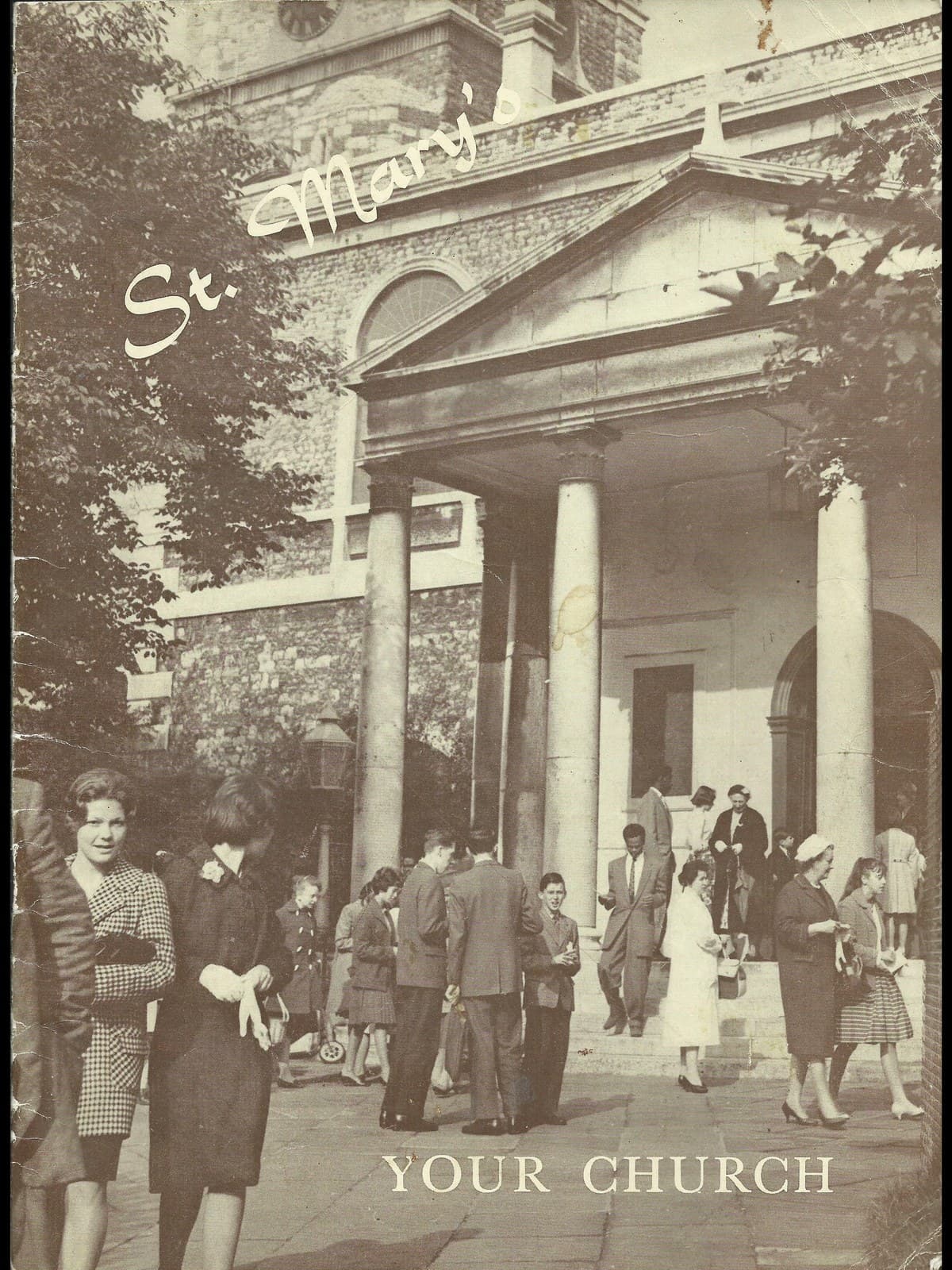
The cover is the best answer this page has to a question it cannot otherwise settle. It is a photograph of the congregation coming out of the west portico after a service — coats and hats, gloves carried, boys in school blazers, a child on the steps — and the congregation in it is Black and white together.
That is about 1960: nineteen years before David Garlick arrived, and twenty-four before the memorial service. It is the earliest evidence in the parish’s own papers of what this congregation actually looked like — and the parish chose it, out of every picture it could have used, for the cover of the booklet it was going to put through the door of every house on its list.
What a parish of this size ran on
The parish printed a directory in the same years, and the staff list on its second page is the shortest way to see the scale of the thing. Under Canon Longworth-Dames, who was Rural Dean as well as vicar, there were four more clergy — one of them chaplain to Ladywell Lodge, and one, the Revd T. B. Fyffe, listed at All Saints’, Enugu, in Nigeria and still counted as St Mary’s staff. Beside them a licensed lay worker and a youth leader.
Five services on a Sunday — Communion at seven and eight, Sung Eucharist at half past nine with parish breakfast in the vicarage afterwards, Matins at eleven, Evensong at half past six — and four more on an ordinary weekday. A crèche in the church during the Sung Eucharist. Sunday schools at a quarter past eleven, infants from three, juniors to nine, and everyone older in house groups.
And this, which is the sentence a reader today is most likely to stop at: the church was open every day from seven in the morning until half past six in the evening. There was a bookstall inside, and a branch of the Bray lending library — so a parish that had given Lewisham its first public library in 1652 still had books to lend three hundred years later.
A clergyman could be found in the church at a quarter past six on any weekday, and at the vicarage at a quarter past seven. The directory asks people to say if they know of anyone who would like a visit, and adds that the clergy are particularly anxious to hear about sick parishioners, or new arrivals in the parish.
Renewal, 1963
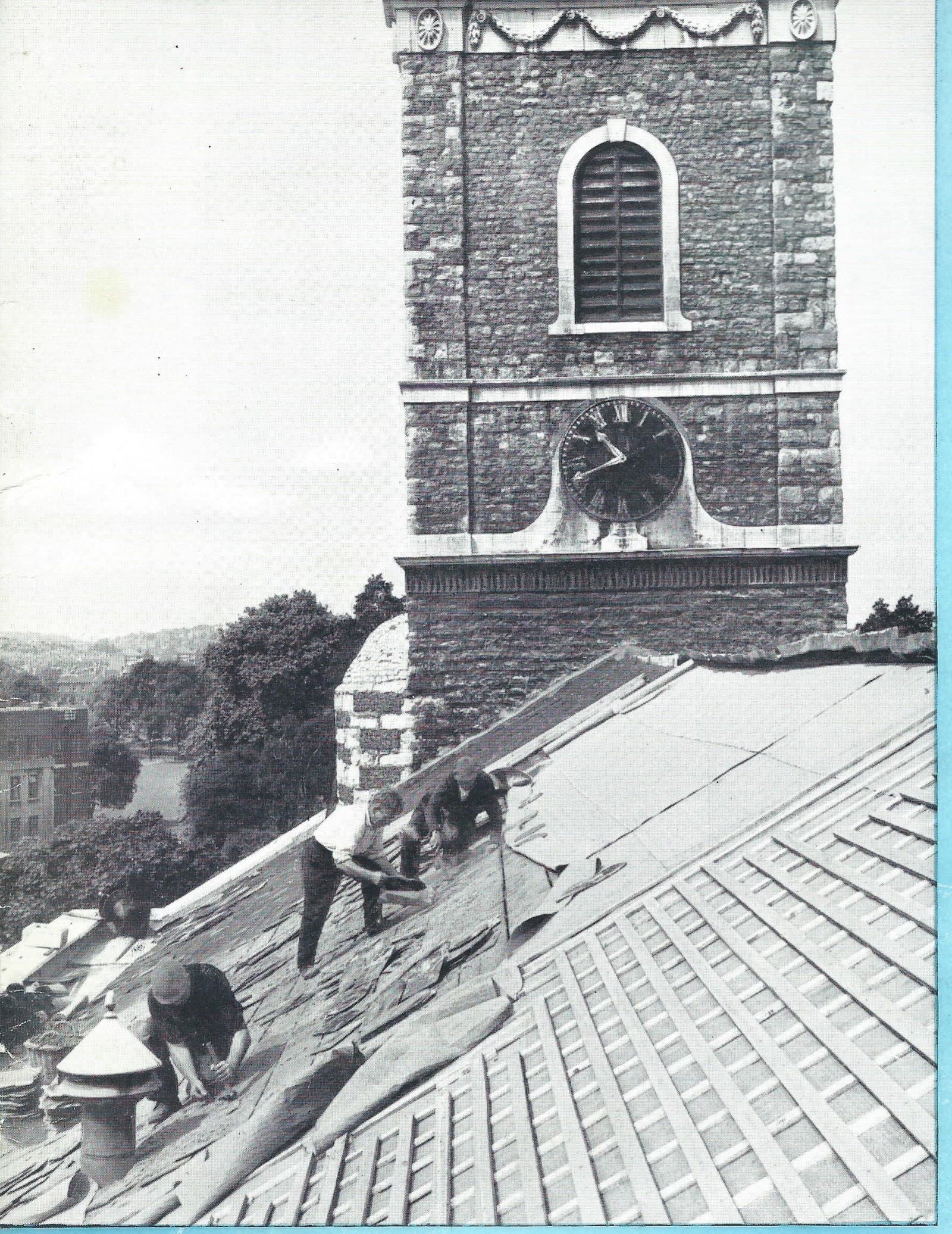
In 1963 the parish published an appeal called Renewal, with that photograph on the cover: four men stripping and re-laying the church roof. Inside, the vicar, Francis Longworth-Dames, wrote to the parish about money and did not apologise for it.
Three years of stewardship giving had paid for the new roof — “this could have been put off and left for future generations to tackle at much greater cost” — and for work on the parish hall, and the parish had borrowed a large sum to put heating into it. He set all of that alongside the Bishop of Woolwich’s harvest sermon on rich countries growing richer while poor ones grew poorer, and the text he took from St Paul: the man who got much had no more than enough, and the man who got little did not go short.
Most of what I have written is about money, and I don’t apologise for this. What we spend our money on shows what we really care about.
The change he was proudest of was not the roof. It was that more fathers and mothers were coming with their children — and that there was now a crèche above the churchwardens’ vestry, staffed by a rota of volunteers, to cope with any children too unruly to stay in the pews.
The Lewisham Experiment, 1978
In April 1978 the Bishop of Woolwich, Michael Marshall, wrote in the diocesan newsletter about something he called the Lewisham Experiment. He had wanted, since coming to Southwark, a base where he could live in community while exercising his ministry south of the river. After two years the opportunity had come at St Mary’s.
The vicarage — some twenty-two rooms, with a large garden — was to be adapted into an open household: a small resident community of men and women, different denominations, and hopefully different cultures, with a refectory, kitchens, a bar and meeting rooms available to the parish and to Lewisham generally. He wrote that a bishop who is available everywhere should nonetheless belong somewhere.
The arrangement was unusual. The bishop was to be instituted to the living of St Mary’s himself, and then commit the pastorate to a vicar, who would hold a cure of souls that was, in Marshall’s phrase, “both mine and his”.
That is why the succession has a gap in it. Harold Bear left in 1977; David Garlick was not instituted until 1979; and in between, the Bishop of Woolwich held this living and lived in the vicarage house. See the vicars of Lewisham and the vicarage house.
The New Cross Fire memorial
On 18 January 1981 a fire at a birthday party in a house on New Cross Road killed thirteen young Black people, all of them between fourteen and twenty-two. Anthony Berbeck, who survived the fire, died two and a half years later; he is counted with them. The conduct of the investigation, and the near-silence of public figures, became one of the defining grievances of Black Britain, and led to the Black People’s Day of Action — twenty thousand people marching on Westminster.
The memorial service was held in this church.
- WelcomeThe Revd David Garlick, Vicar of St Mary's
- PrayerBishop L. E. White, Pastor of the Bibleway Pentecostal Church, Lewisham
- Old TestamentThe Revd Barry Carter, United Reformed Church
- New TestamentThe Revd V. J. Watson, Methodist Church
- The GospelThe Revd David Garlick
- The SermonMrs Sybil Phoenix, Methodist Church
- The PrayersFr Gerald Flood, Roman Catholic Church
- Russian ContakionSung by St Mary's choir
Read down that list and the shape of it is the story. The Anglican parish church provided the building, the welcome and the choir. The prayers were led by a Black Pentecostal bishop from Lewisham and a Roman Catholic priest. The readings were taken by United Reformed and Methodist ministers. And the sermon — the one thing a vicar would ordinarily keep — was preached by Sybil Phoenix.
Sybil Phoenix came to London from Guyana in 1956, fostered more than a hundred children, and ran the Moonshot Club in New Cross until it was burned down by arsonists in 1977. She was the first Black woman appointed MBE. When this parish had the chance to say something about the deaths of thirteen young Black people, it handed the pulpit to her.
The order of service is dated “Sunday January 15th, 1983”, and that cannot be right: it commemorates Anthony Berbeck, who died on 9 July 1983, and 15 January 1983 was a Saturday. 15 January 1984 was a Sunday. The service was on the third anniversary and the printed year is the mistake everybody makes in January.
The peace vigil, 1983
A month before that memorial, the church held a twenty-four-hour peace vigil — and the first candle was lit by Michael Heseltine, Secretary of State for Defence.
He accepted the invitation the evening before, the same week the General Synod voted to reject the unilateralist report The Church and the Bomb. A tip-off gave local CND supporters a couple of hours to make banners calling him a hypocrite and gather twenty people to sing Give Peace a Chance as he left. He stood in front of a congregation of several hundred schoolchildren and sang Make me a channel of your peace.
The Guardian described the vicar, David Garlick, as a unilateralist, and reported that he was pleased Heseltine had accepted at the last minute. When Heseltine lit his candle he spoke words from the Te Deum — prepared for him by the vicar — which were the same words the Bishop of Salisbury, author of the report the Synod had just rejected, had used to conclude his speech to that Synod.
Heseltine said only: “I was invited here by the vicar, and it seemed to me that this week of all weeks it was right to say yes.”
And the squirrels
Not everything was momentous. In October 1985 the Mercury reported that a wedding at St Mary’s had been met, instead of a trumpet fanfare, with discordant noises from the organ — and that the vicar had felt obliged to apologise and explain: It’s those squirrels again.
Julian Watson remembers the symptom rather than the headline. The damage was to the action, and some notes would go on sounding long after the key had been let go — which he describes, with feeling, as very embarrassing for the organist.
They had been nesting in the pipes, hoarding nuts and nibbling the woodwork, and could be heard scrambling overhead during the prayers. The trumpet pipes had stopped speaking and the electric action was affected. The parish was appealing for £6,000, and raising it with a production of Fiddler on the Roof, a rock musical written by young members of the church, and a river disco.
It is a funny story with a sad end. That organ never fully recovered; the action went on failing, and the instrument was taken out during the re-ordering ten years later and never replaced in kind. See music and the organ.
A year in the life, 1991
The parish printed a diary for 1991, and it shows something no occasion-piece does: what an ordinary year looked like. Sung Eucharist at ten, Evening Prayer sung at half past six, a said mass every weekday including one at Lewisham Hospital chapel on Thursdays, confessions on Saturday after Evening Prayer, and Sunday School in St Mary’s Centre behind the church.
The striking thing is how the congregation was organised. It was divided into “mini parishes”, each named after a street or corner of Lewisham and each meeting one evening a month: Chudleigh, Slaithwaite, Algernon, Wearside, Mount Pleasant and Lewisham Park. A congregation of a few hundred, split into six neighbourhoods, meeting where people lived.
They lasted the better part of forty years. They ran until Covid, and they have not come back. That is not unusual — a great deal of parish life stopped in March 2020 and never restarted — but it is worth writing down while there are still people who remember which mini parish they belonged to.
And on the first Friday of the month there was a Glebe Mass at a quarter past twelve — said in the almshouses across the road, which are still there. See the linked charities.
The clergy that year were Fr David Garlick and Fr Stanley Nyahwa, with Helen King as pastoral auxiliary. The Mothers’ Union ran a practical parenting evening with a panel of experts, a kneeler workshop, and a talk called “Our Nigerian Links”. There was a video group every Tuesday, a fun run and a fete.
The man all of this happened under
Everything on this page from 1979 onwards belongs to one incumbency. David Garlick was Vicar of Lewisham for twenty-eight years — the fire memorial, the peace vigil, the squirrels in the organ, the year in the diary, the re-ordering of the church itself.
A Yorkshireman, he went to Wakefield Grammar School, did his National Service in Germany, read Theology at Nottingham and trained at St Stephen’s House. Ordained deacon in 1964, he was drawn to Southwark by Mervyn Stockwood and served his title at St John the Divine, Kennington, in the years when Stockwood, John Robinson, Nick Stacey, Ernie Southcott, Douglas Rhymes, Eric James and Hugh Montefiore were making what became known as Southbank Religion. He was youth worker at St Paul’s, Lorrimore Square, Priest in Charge of St Peter’s, Vauxhall from 1968, and came here in 1979. He stayed until his — the obituary’s own parenthesis — (reluctant) retirement at seventy, in 2007.
His friend Canon Andrew Grant, who had been a curate alongside him at St John the Divine and said the Offices with him in retirement from the next flat in Catford, wrote the notice. Its verdict on what he did in this parish is one sentence:
Firmly against the ordination of women to the Priesthood, David changed St Mary’s, Lewisham, from a rather staid civic church to a lively, community centred, Catholic church in the Anglican tradition and part of the Forward in Faith movement.
That is history, and it is not where this parish now stands. St Mary’s has been fully supportive of the ordination of women since 2012, and has been throughout the two incumbencies since. The sentence above is kept because it is what Garlick’s friend wrote about him and because the parish’s own record is not improved by editing; it is not a description of the church you would walk into today.
Parishioners called him a people’s priest who was liable to visit at any time. Grant is not sentimental about the rest of it: he found authority difficult, his relations with bishops and archdeacons were always problematical, and he loved a fight — but it was always a fight for what he saw as the good of the parish. His own religion was the daily Mass and the two Offices, every day.
Carriacou
There is one thread running the whole length of his ministry that the parish papers do not mention at all. For more than twenty-five years David Garlick was Commissary of the Bishop of the Windward Islands — a bishop’s formal representative, acting for him at a distance. He served in Carriacou, the small island north of Grenada, and was, in Grant’s words, much loved there. He was also Commissary to the Bishop of Mozambique, and travelled widely in Africa, the Caribbean, India and the United States.
He died on holiday in Grenada in the first days of February 2016, on Bathway beach, of a heart attack, in the company of friends from England — one of them another former Commissary. He was seventy-eight. His funeral, back at St John the Divine, was packed.
What that does and does not show. It establishes beyond doubt that the vicar of this parish spent a quarter of a century in formal service to a Caribbean diocese, throughout the years his own congregation in Lewisham was changing. It does not, by itself, document how he welcomed the Windrush generation into this church — the memorial service of 1984 is still the only thing on paper here that shows the parish and Black Lewisham in the same room. The obituary’s one line about a constant stream of friends, old and young, black and white describes his retirement house in Yorkshire, not this vicarage, and this page will not borrow it. That gap is a question for people who were here, not for the archive.
The borough comes back, 1990
On the evening of Sunday 10 June 1990 the London Borough of Lewisham held its Annual Civic Service in this church, to mark the inauguration of the new civic year. The order of service is in the parish’s papers, with the borough’s crown on the cover.
The instruction to the congregation is the best thing in it:
The congregation being assembled, all stand at the entry of the Choir. The Churchwardens and Clergy meanwhile attend at the West Door of the Church to greet the Worshipful the Mayor of Lewisham with the Civic Party.
The churchwardens of Lewisham, going to the west door to meet the Mayor of Lewisham. Ninety years earlier this parish was the local authority, and its own magazine reported the handover to the new borough as a great change and wished it well. The two offices met again on the steps in 1990, and the older one held the door.
They sang Adrian Batten’s Sing we merrily unto God and Christ is made the sure foundation.
Who remembers it now
The New Cross Fire is now commemorated by St Andrew’s, the United Reformed church in Brockley, and it is right that the families and the community who carry that memory should be the ones who lead it. This parish does not claim the commemoration.
What is recorded here is what happened in this building in January 1984, because it is in the parish’s own papers and nowhere else. The thirteen are not forgotten in this church, and anyone who wants to remember them here is welcome to.
What is not on this page yet
A great deal. The parish holds scans of the 1931 millenary celebrations and parish magazine, a pageant in 1933, the Roll of Honour of 1916, a twelve-part stewardship campaign from 1960, a parish diary from 1991, and lists of assistant priests from 1880 to 1956 and churchwardens from 1498 to 1956. None of it has been read properly.
And the twentieth century is still within living memory. If you were here — particularly in the 1980s, and particularly if you can say anything about how this church came to be the one that held that service — the parish office would be glad to hear from you.
Where this comes from
This parish is fortunate in its historians. Three works stand behind these pages, and none of them is ours.
St Mary's Church Lewisham: History (2004, revised 2017)
Julian Watson
Copyright Julian Watson, used with his permission. The greater part of what is written here comes from this book and from his unpublished research, and any of it that is wrong is our doing rather than his.
The Churchyard of St Mary the Virgin, Lewisham (1992)
Ken White
Copyright Ken White, used with his permission.
The Church Record of St Mary the Virgin, Lewisham
The Arts Society Blackheath and The Arts Society Greenwich, completed by the Church Recording Society, 2021–2024
A catalogue of every object in the building, begun in the incumbency of Canon David Garlick and finished in that of Fr Steve Hall. The descriptions, measurements and attributions of the monuments come from it.
The Parish Church of Saint Mary, Lewisham, Kent (1892)
Leland L. Duncan, F.S.A.
Out of copyright, so this is a citation rather than a licence — but it is the single largest source for the medieval parish, the tower bequests, the churchyard, the vicarage house and the medieval vicars, and its six plates are the earliest images the parish has. Duncan was honorary secretary of the Lewisham Antiquarian Society, which met in the parish church hall, and he was educated at Colfe's — the school one of these vicars founded.
Canon David Garlick’s obituary is by Canon Andrew Grant, in The Bridge, the newspaper of the Diocese of Southwark, May 2016. The account of his death and of his twenty-five years as Commissary is from the Bishop of the Windward Islands’ circular of 5 February 2016. Everything else on this page comes from the parish’s own papers.
Some of these captions are guesses. Please correct us.
The parish archive runs to well over a thousand photographs, most of them unlabelled. Where a caption here rests on a filename rather than on a document, it says so — but we will have got things wrong that we do not yet know are wrong.
If you recognise a place, a face, a date or an object, we would be very glad to hear from you, and we will change the page and say who told us. Photographs of the church before the 1990s re-ordering, and anything at all of the choir, would be especially welcome.
Text and images are the copyright of their authors unless otherwise stated. If you would like to reproduce anything from these pages, please ask us and we will put you in touch with the right person.