Worship
Our Lady of Lewisham
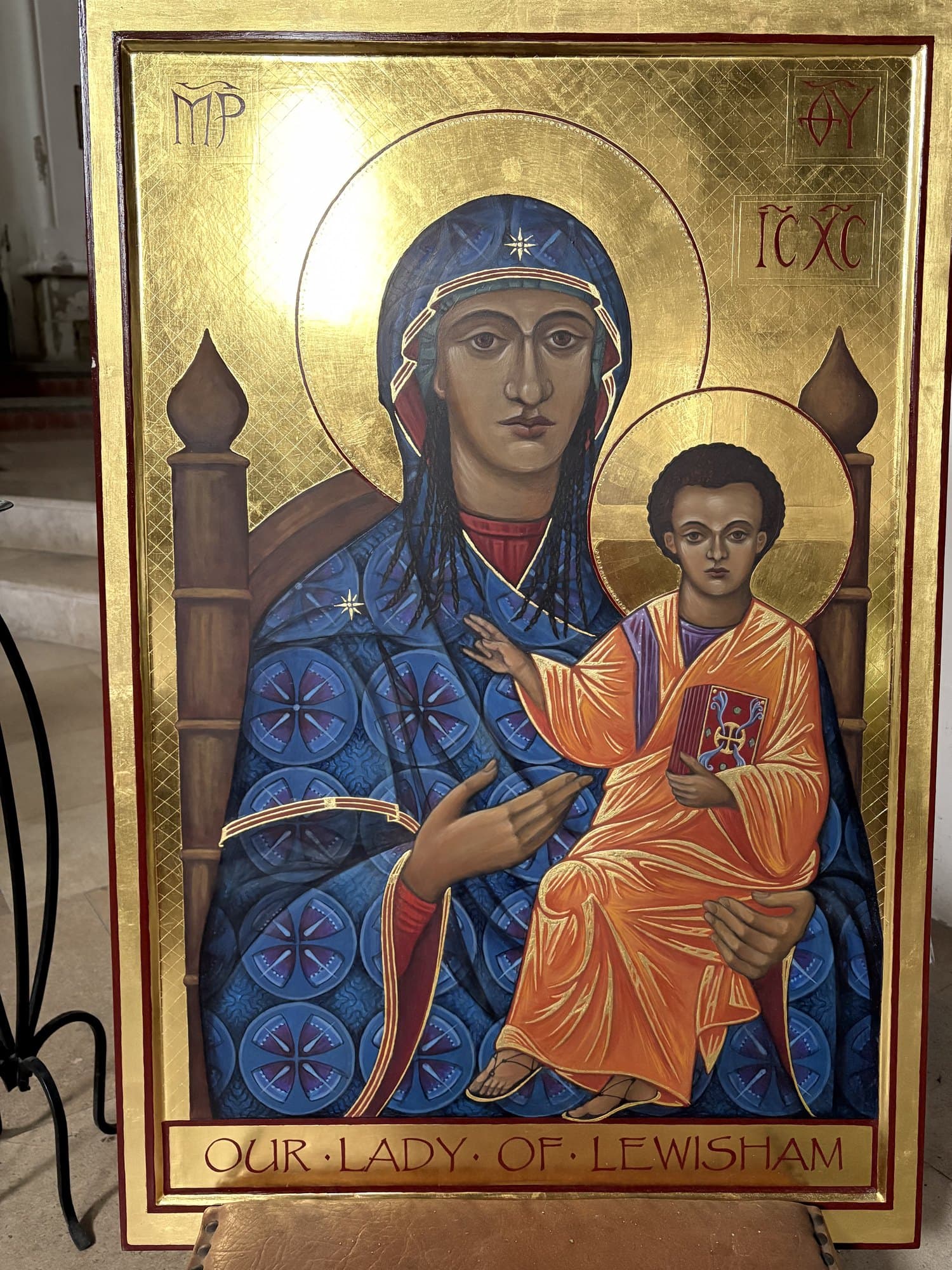
An icon of the Mother of God as a Black woman, designed by Lewisham schoolchildren, with the holy well that named Ladywell held in her son's hands.
There has been devotion to Our Lady in Lewisham for a very long time. The neighbourhood next to this church is called Ladywell after a holy well, and the well was Our Lady’s. The church itself is dedicated to St Mary the Virgin.
What the parish did not have, until recently, was an image. It has one now.
Where it came from: a school, and its pupils
The first icon of Our Lady of Lewisham was not made for this church. It was made in 2015 for Trinity Church of England School in Lewisham, and it was commissioned by Richard Peers, then its Head Master. The iconographer was Helen Dejean.
The design was the pupils’. Peers has written that they were determined that both Mary and Jesus should be properly African, in shape of face, skin colour and hair — and they are. Christ’s hair is an afro; Mary’s braids come down from under her veil. The cloth of her mantle reproduced West African kente, worked with the school’s own logo. Four medallions across the top stood for the four archangels the school Houses were named after. At the foot ran two rivers, the Quaggy and the Ravensbourne, and between them the well.
A group of Black children in a Lewisham school looked at fifteen hundred years of European pictures of the mother of Christ, and decided she should look like them. That is the origin of this image, and it is not a footnote to it.
And then a second, for the parish
When Fr Steve Hall left St Mary’s, he commissioned a second icon from the same painter for the church. It was delivered in December 2025 and consecrated by the Bishop of Southwark on 7 June 2026. It is painted on a panel of seasoned linden wood and measures 95 by 63 centimetres, four and a half centimetres thick with its battens.
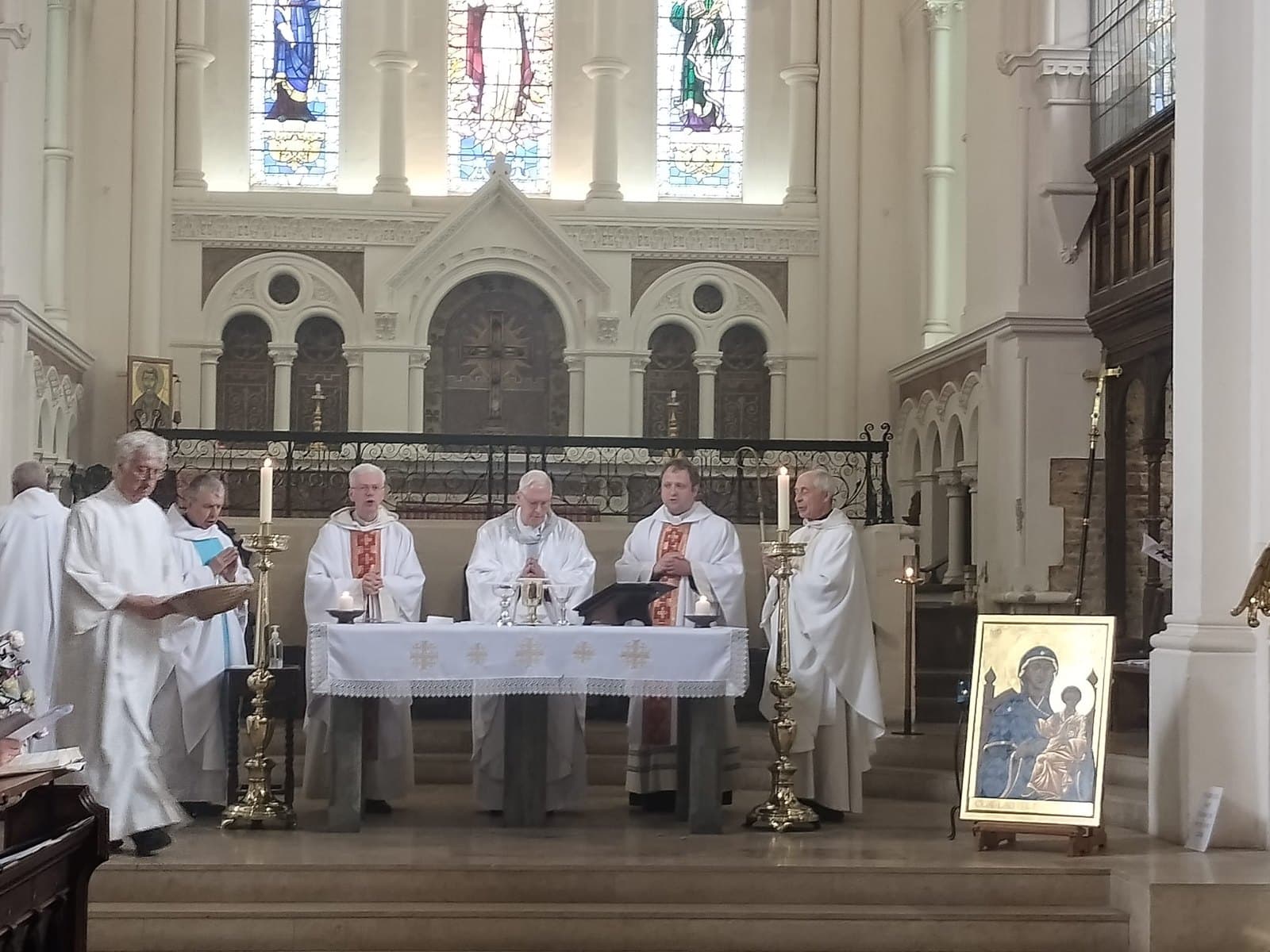
It is the same two figures and it is not the same picture. Everything that belonged to the school has gone: no archangel medallions, no school logo in the cloth, no rivers along the bottom. What it keeps is the thing that makes it Lewisham’s rather than anywhere else’s.
The well is on the Book. In the school’s icon it lay at the very bottom, on the ground, between the two rivers. In this one the Christ Child holds a red Gospel book, and worked into its cover is a gold ring around a cross with four springs of water curling out of it. The holy well of Ladywell has come up off the floor and into the hands of the one being pointed at.
What to look at
- ΜΡ ΘΥ and ΙϹ ΧϹ, in the upper cornersAbbreviated Greek: Mother of God, and Jesus Christ. They identify the figures. An icon is not a portrait and does not rely on being recognised.
- Three stars — brow and both shouldersThe traditional mark of Mary's virginity before, during and after the birth. Two of the three are visible from the front.
- Her right hand, turned towards the ChildThe gesture that names the type: Hodegetria, She Who Shows the Way. She is not the subject. She is pointing away from herself.
- The turned wooden throneThe seat of wisdom — in the school's version, explicitly the teacher's chair.
- A gold ring enclosing a cross on the red Book, with four springs of water curling out of itThe Ladywell. In the first icon it sat at the very bottom between two rivers; here it has been lifted onto the Gospel the Child is holding.
- Gold ground, scored all over with a fine latticeNot a background. Gold is not a colour in an icon, it is light, and nothing is behind the figures because there is no elsewhere.
Painted, not written
People often say that an icon is written rather than painted. Helen Dejean, who painted this one, has explained in print where that comes from and does not use it. Greek and Russian each have a single verb covering both senses; English does not, and the phrase icon writing is a translation artefact often innocently echoed by those newly beguiled by the subject. Long-established iconographers, she says, talk about icon painting. So does this page.
What is behind the idea is true even if the word is not. An icon is not an artist’s impression. There are hundreds of variants of the Mother of God, each grown from an ancient archetype with its own scriptural and liturgical meaning, and a painter works inside that inheritance rather than inventing. It is built up in egg tempera over gesso on board, in ten or fifteen pigments, working from dark to light, with the robes and the ground finished before the faces and the hands.
She lectures in art history at the Courtauld Institute and specialises in trecento panel-painting and Russian and Byzantine icons. Her account of how icons are made, published under her former name of Helen McIldowie-Jenkins, is on The Arts Society, and the fullest description of the first icon is in a sermon by Richard Peers, who commissioned it.
Where it will hang, and why there
An icon in a church is not hung where it looks best. Helen Dejean came and saw the building in October 2025 and recommended the east wall of the north transept, by the Lady Chapel — so that seen from the nave it stands to the left of the sanctuary.
That is not a matter of sightlines. In an Orthodox church the main image of the Mother of God goes to the left of the Royal Doors of the iconostasis, and the left of a pair. Stand where the congregation stands and the geometry inverts: the position on your left is the position at the right hand of the God present in the sanctuary. Where she is put is a statement about where she is.
It is not there yet. The faculty — the permission needed before anything is fixed to the wall of a listed church — is what these notes were written for.
The curtain
The plan is for the icon to be veiled: a dark blue curtain, matching the blue of Mary’s mantle, on a narrow brass rod, drawing back to the left.
There are two plain reasons — it can be covered in Lent, and it is some protection against anybody who might want to damage it. But the practice is very old, and Helen Dejean’s notes set out the company it puts this parish in. Greek churches still curtain their miraculous icons in brocade and embroidered silk, perhaps in memory of the relic of the Virgin’s own veil once kept in the imperial palace at Constantinople.
And at the Hodegon monastery in the same city there was the Tuesday miracle: the great Hodegetria of the Virgin and Child — the type this icon belongs to, the one where she points to her son — was revealed every week when the curtain hiding it raised itself.
The idea travelled. At Orsanmichele in Florence, Bernardo Daddi’s Virgin of about 1347 sat in Orcagna’s tabernacle of 1359 with curtains carved into the frame, held by angels — and a system of pulleys inside the shrine to draw the real ones back for pilgrims. A blue curtain on a brass rod in a Lewisham transept is the modest end of a very long tradition.
Coming to pray
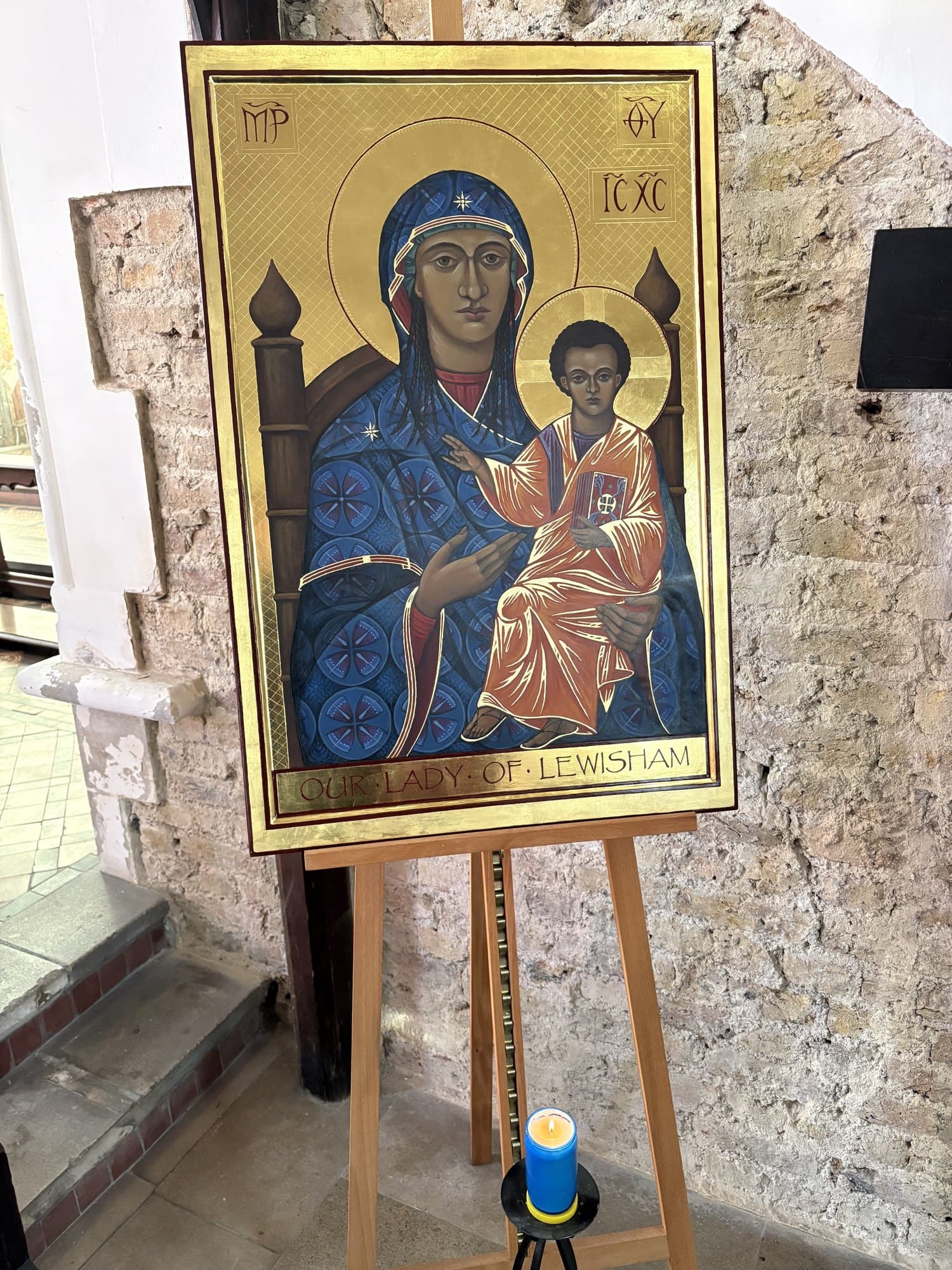
It is not in a case, and it is not yet in its permanent place — in the photograph above it is standing against the medieval stone with a candle in front of it, which is where it waits rather than where it will live. It is there for the ordinary reason such things are there.
You do not have to be a churchgoer, or a Christian, or sure about any of it. People light a candle for somebody who is ill, or somebody who has died, or somebody sitting an exam. The church is open — the times are here — and if you would rather somebody else prayed, you can ask us to.
The well that gave Ladywell its name is on its own page, and the parish dedicated to St Mary since before the Conquest is on our history pages.