History & Heritage
The Ghent connection
For 496 years this parish was the property of an abbey in Flanders. It was given away by Alfred the Great's youngest daughter, confirmed by a saint who had sheltered there in exile, and taken back by Henry V over the Abbot's written protest.
It is the longest single fact about Lewisham and the strangest. From the tenth century to the fifteenth, the manor, the church and the right to appoint its priest belonged to the Benedictine abbey of St Peter at Ghent, some two hundred miles away across the sea. Rents from the Ravensbourne mills went to Flanders. The vicar was presented by a Flemish abbot. When England went to war with France the Crown seized the parish as enemy property, and gave it back when peace came.
Ælfthryth’s gift, 918
Alfred the Great’s youngest daughter was called Ælfthryth in England and Elstrudis in Flanders. She married Baldwin II, Count of Flanders, and held Lewisham with Greenwich and Woolwich as her own inheritance.
On 11 September 918, after her husband’s death, she gave the three of them to the abbey of St Peter at Ghent, for the good of his soul and her own and her sons Arnulf and Adelolf. The charter has her say she gives and delivers utterly her property at Lievesham, Gronevic and Vuluvich.
She died at Ghent in 929 and was buried beside Baldwin in the abbey church. So the woman who gave Lewisham away lies in the place she gave it to, and has done for eleven hundred years.
Is 918 right?
Not certainly, and the parish should say so.
- No original of the charter survives. It is known from copies in the Ghent archives, the earliest of them made in the middle of the thirteenth century — more than three hundred years after the event.
- Scholars disagree about it. In the standard catalogue of Anglo-Saxon charters it is numbered S 1205a and b; the Belgian historian Jan Dhondt marked it spurious in 1940, while Philip Grierson, Simon Keynes and David Pelteret have all examined it without going that far.
- The parish has itself counted differently. In 1931 it kept a fortnight-long festival, 31 May to 14 June, which the parish magazine and the Parochial Church Council both call in so many words the 1,000th Birthday Festival of the Church. That points to about 931, and to a church rather than a manor. In 2018 the parish kept eleven hundred years, which points to 918. Both cannot be right.
What is not in doubt is that the connection existed and lasted. King Edgar confirmed it in 964, and after him almost every king was at some point obliged to confirm it again. Whatever the first document was, something real stood behind it.
The careful line, which the parish’s own Church Record already takes, is that the grant of the manor has a date and the church does not. Nobody knows when the first building went up here. Duncan’s guess in 1892 was that the monks would have sent an official to manage the property soon after the grant, and that a place to worship would have followed if one did not already exist.
Dunstan, who had been there
King Edgar’s charter of 964 confirms the gift and adds Mottingham and Combe. It describes the land in a phrase Duncan liked enough to open his book with — the place which the rustics from ancient custom have called Lievesham — and says the grant is made through the intercession and friendship of my devoted and very kind friend Archbishop Dunstan. It ends by warning that anyone who conspires to dishonour the gift will hear God say, on the Day of Judgement, Depart from me, ye cursed.
Dunstan’s friendship for Ghent was not abstract. King Eadwig had exiled him, and he took refuge at St Peter’s. The man who secured Lewisham to a Flemish abbey had lived in it as a fugitive.
Lost to the Danes, and vowed back
The connection nearly ended in the eleventh century. Danish armies wintered at Greenwich between 1011 and 1016 — it was there that Archbishop Alfege was murdered for refusing to let a ransom be paid for him — and the abbey appears to have lost its English lands in the upheaval.
They were recovered by a king who knew Flanders well. Edward the Confessor spent years of his youth in exile, and in 1016, while at Ghent, he vowed that if he came into his kingdom he would restore Lewisham, Greenwich and Woolwich to the monks. In 1044, as king, his charter did exactly that.
How a Flemish abbey ran an English parish
The estates were managed from a priory at Lewisham, with a court house and guest house at Greenwich. It was a cell of Ghent rather than a monastery in its own right: a small establishment whose real business was collecting rents and sending them home.
Two men have left descriptions of it. In 1332 Jacob Bruyning reported to the Abbot that the priory had a chapel with an altar stone; a library of church books, among them a breviary on which those attending the manor court took their oath; a pantry, a kitchen, a hall and a bedroom; and, for the farm, a brewery, a granary and stables. In 1396 Gilles Delaporte recorded simply that the priory stood in the centre of the town of Lewisham, its buildings arranged around a courtyard with the farm buildings tiled.
Nobody now knows where it stood. Three sites have been proposed: Church House beside St Mary’s; the house at the junction of the High Street and Albacore Crescent that a later owner named The Priory; and Priory Farm at Rushey Green, on the corner of Ringstead Road, which was moated and had ancient foundations. The centre of the town has moved since 1396, which is part of the difficulty.
The church itself was appropriated to the abbey in the reign of Henry II, by the Bishop of Rochester, on terms that the abbey would present a clerk to serve it as vicar. That is the origin of the office — Lewisham has vicars rather than rectors because a Flemish monastery took the rectory and paid a deputy. By an agreement of 1218 between the Bishop and the Abbot it was laid down that the vicar of Lewisham ought to be properly housed.
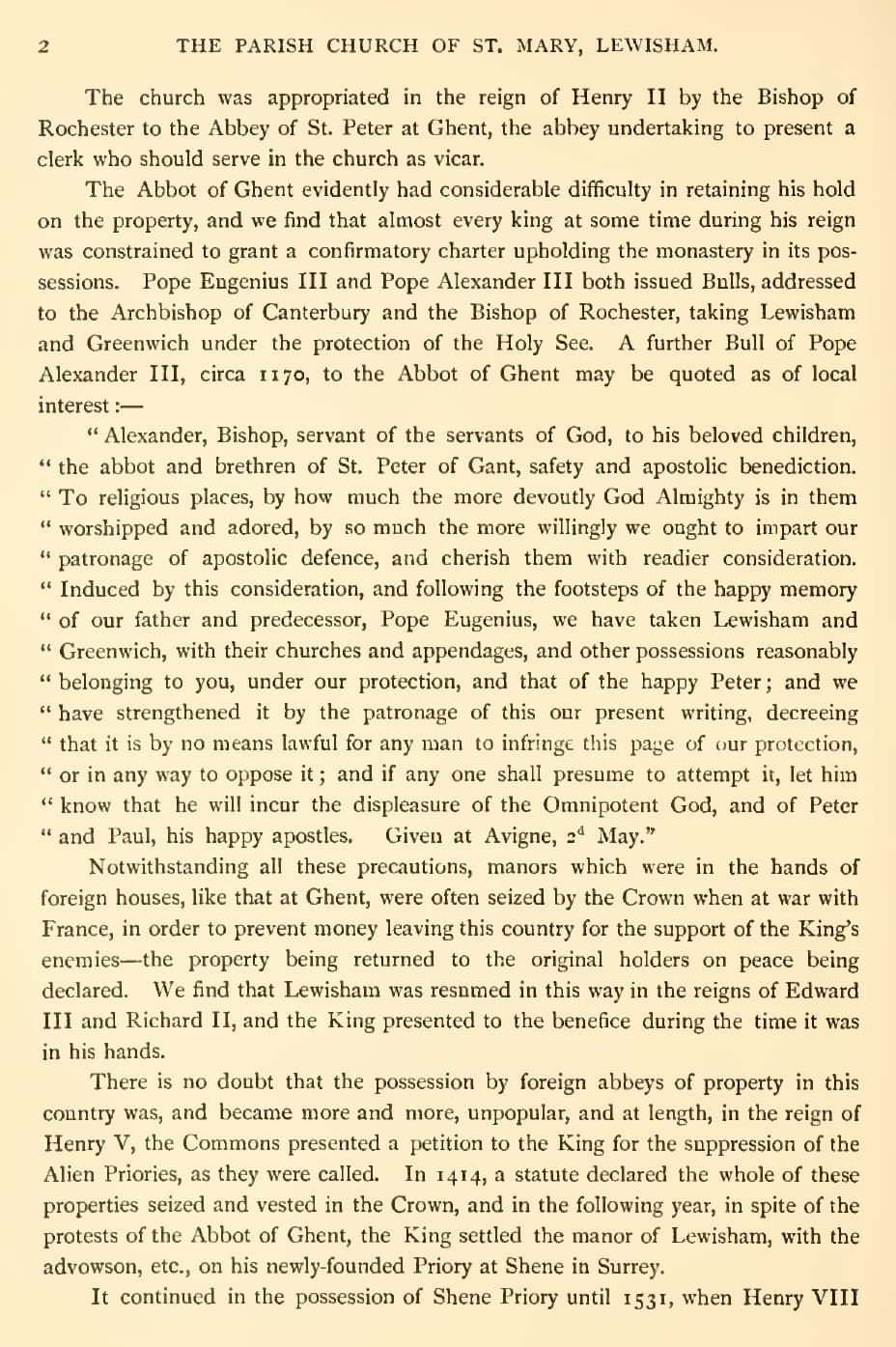
Rome took an interest too. Popes Eugenius III and Alexander III both issued bulls to the Archbishop of Canterbury and the Bishop of Rochester taking Lewisham and Greenwich under the protection of the Holy See, and warning that anyone infringing it would incur the displeasure of the Omnipotent God, and of Peter and Paul, his happy apostles.
In 1229 Pope Gregory settled a dispute over tithes by ordering Bermondsey Abbey to pay Ghent two wax candles of a pound and a half, in the chapel of the Blessed Mary at Lewisham, on the eve of the Nativity of the Virgin.
Sanctuary, 1254
One incident survives that shows the priory and the church working as parts of the same machine. In 1254 Geoffrey le Bidelede and Margery David beat to death Agnes, daughter of Roger le Biche, and were brought before the court of the Prior of Lewisham as representing the lord of the manor, and imprisoned to await trial.
Margery escaped from the Prior’s prison and fled to the parish church — and there, before William Scot the bailiff, abjured the realm. She took sanctuary in this building and bought her life with exile.
The end, 1414
Foreign ownership of English land grew steadily less tolerable as the wars with France went on. Lewisham was seized by the Crown more than once — under Edward III and again under Richard II, and while it was in the King’s hands the King presented to the benefice. The estate was eaten into from other directions as well: by subdivision before the statute of Quia Emptores in 1290, by sales the Abbot made himself, and by neighbours advancing claims that were hard to disprove from Flanders.
In 1414 a statute of Henry V declared the alien priories’ property seized and vested in the Crown. The following year the King settled the manor of Lewisham, with the advowson, in spite of the protests of the Abbot of Ghent, on the Carthusian priory he had just founded at Sheen.
Four hundred and ninety-six years, ended by an Act of Parliament and an objection that changed nothing.
And afterwards
Sheen held Lewisham until 1531, when Henry VIII — having failed to dislodge the Prior on a legal technicality — obtained the manor by exchange, to enlarge his estate at Greenwich. It passed through the Crown, the Earl of Holderness, the Ramsays and Reynold Graham, and in 1673 to Graham’s nephew George Legge, afterwards Baron Dartmouth, whose family holds the patronage still. That descent is set out on the vicars of Lewisham.
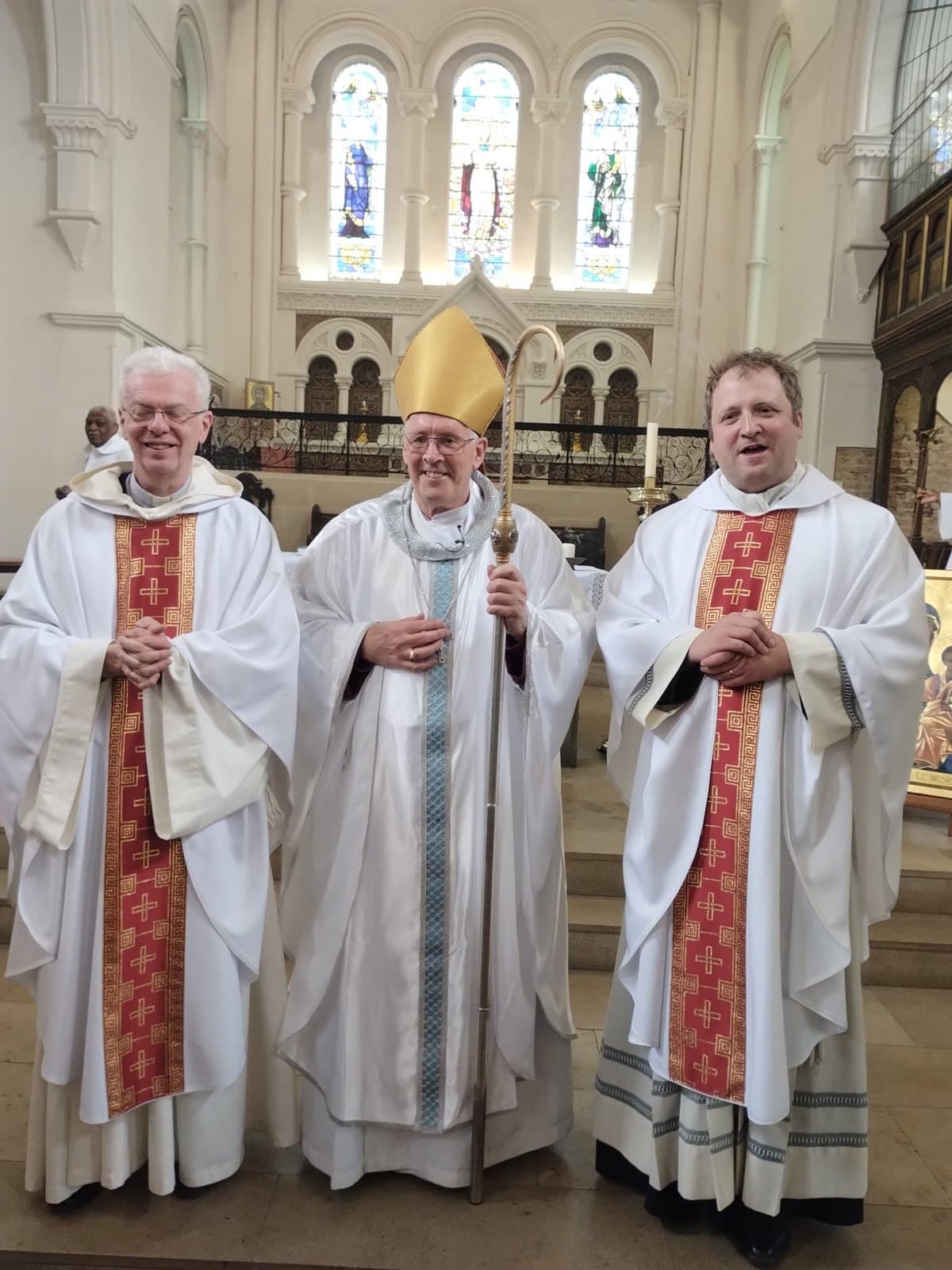
The Flemish connection did not disappear with the property, and it is not a memory. The two parishes visit each other in alternate years. Ghent came to Lewisham for the induction of the present vicar in 2025, and again on 7 June 2026, when Fr Jürgen Francois, priest of St Peter’s, stood with the Bishop of Southwark for the blessing of the new icon of Our Lady of Lewisham. St Mary’s goes to Ghent in July 2027.
The parish’s own history of the church is dedicated jointly to the congregations of St Mary the Virgin, Lewisham and the Abbey Church of St Peter and St Mary, Ghent.
Eleven hundred years after Ælfthryth signed a document in Flanders, the two churches are rather more than on speaking terms. A priest from Ghent was standing in this building this summer, watching a bishop bless a picture of Our Lady with the Ladywell painted into it.
Elsewhere on this site
The shape of the parish Ghent owned, and what became of it, is on the ancient parish. The men the abbey and its successors appointed are on the vicars of Lewisham. And the building itself, through all of this, is on the history pages.
Where this comes from
This parish is fortunate in its historians. Three works stand behind these pages, and none of them is ours.
St Mary's Church Lewisham: History (2004, revised 2017)
Julian Watson
Copyright Julian Watson, used with his permission. The greater part of what is written here comes from this book and from his unpublished research, and any of it that is wrong is our doing rather than his.
The Churchyard of St Mary the Virgin, Lewisham (1992)
Ken White
Copyright Ken White, used with his permission.
The Church Record of St Mary the Virgin, Lewisham
The Arts Society Blackheath and The Arts Society Greenwich, completed by the Church Recording Society, 2021–2024
A catalogue of every object in the building, begun in the incumbency of Canon David Garlick and finished in that of Fr Steve Hall. The descriptions, measurements and attributions of the monuments come from it.
The Parish Church of Saint Mary, Lewisham, Kent (1892)
Leland L. Duncan, F.S.A.
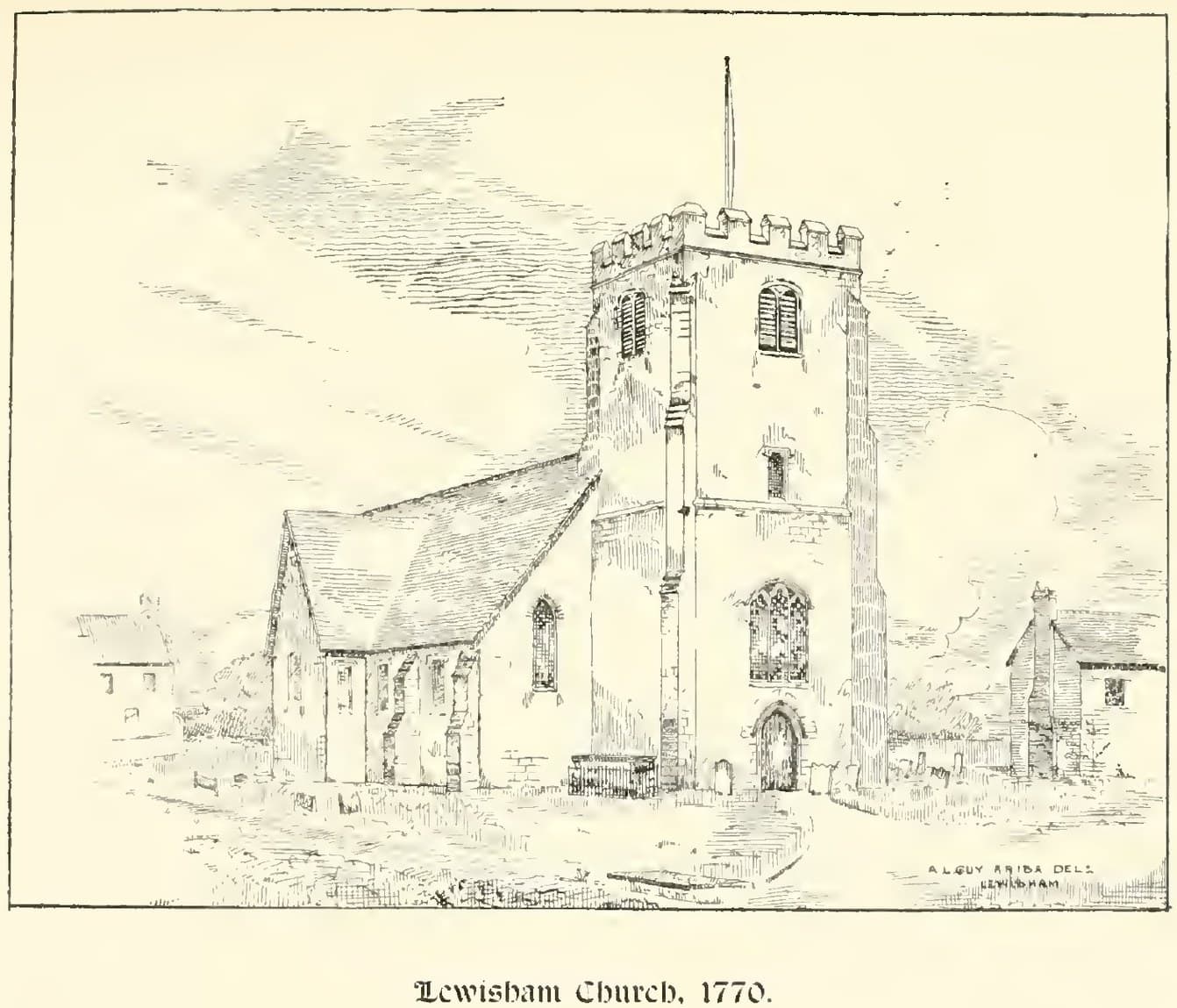
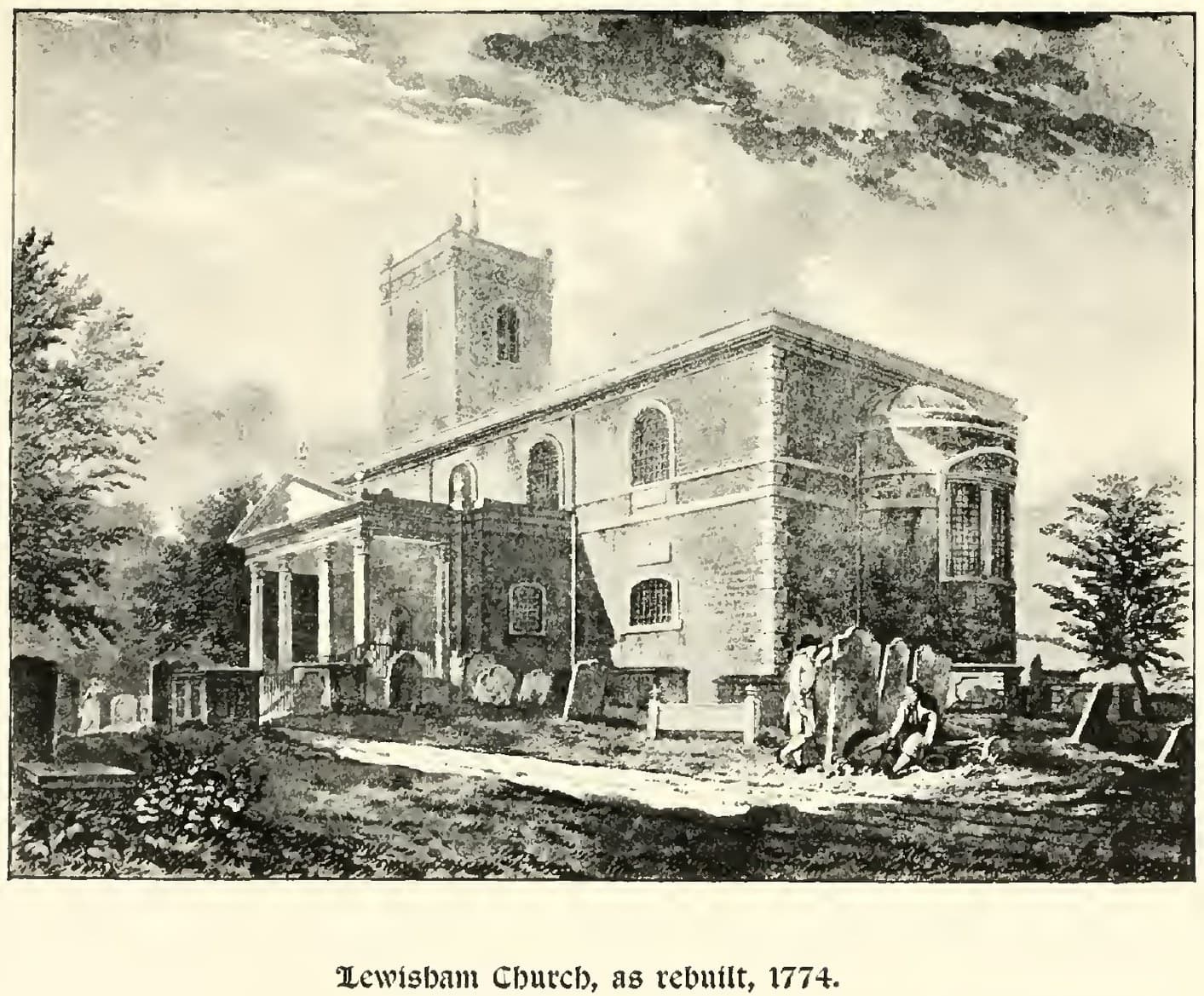
Out of copyright, so this is a citation rather than a licence — but it is the single largest source for the medieval parish, the tower bequests, the churchyard, the vicarage house and the medieval vicars, and its six plates are the earliest images the parish has. Duncan was honorary secretary of the Lewisham Antiquarian Society, which met in the parish church hall, and he was educated at Colfe's — the school one of these vicars founded.
Some of these captions are guesses. Please correct us.
The parish archive runs to well over a thousand photographs, most of them unlabelled. Where a caption here rests on a filename rather than on a document, it says so — but we will have got things wrong that we do not yet know are wrong.
If you recognise a place, a face, a date or an object, we would be very glad to hear from you, and we will change the page and say who told us. Photographs of the church before the 1990s re-ordering, and anything at all of the choir, would be especially welcome.
Text and images are the copyright of their authors unless otherwise stated. If you would like to reproduce anything from these pages, please ask us and we will put you in touch with the right person.