History & Heritage
The monuments
A midwife who took no payment for forty years, a signed Flaxman, the first stamp collector in the world, and a poet nobody could help.
The church and churchyard are full of monuments, and they are not a neutral record. They commemorate the people who could afford to be commemorated, in the words their families chose. Read with that in mind they are one of the best things about the building.
In the church
Margaret Colfe
died 1643
A simple memorial
Born Margaret Hollard, or Holland — her family used both spellings. Wife of Abraham Colfe — curate here from 1604 and then vicar for forty-seven years, over fifty in the parish altogether — and previously married to Jasper Valentine, a Lewisham tanner, by whom she had a son, Richard. Her memorial records that she had “bene above 40 years a willing nurse, midwife, surgeon, and in part physitian to all, both rich and poore, without expecting reward”, and that she left twenty shillings a year to the poor. She was nearly seventy-nine.
Julian Watson on Margaret Colfe — 1 min 14
Mary Lushington
1771–1797
Nave, north side, west of the doorcase
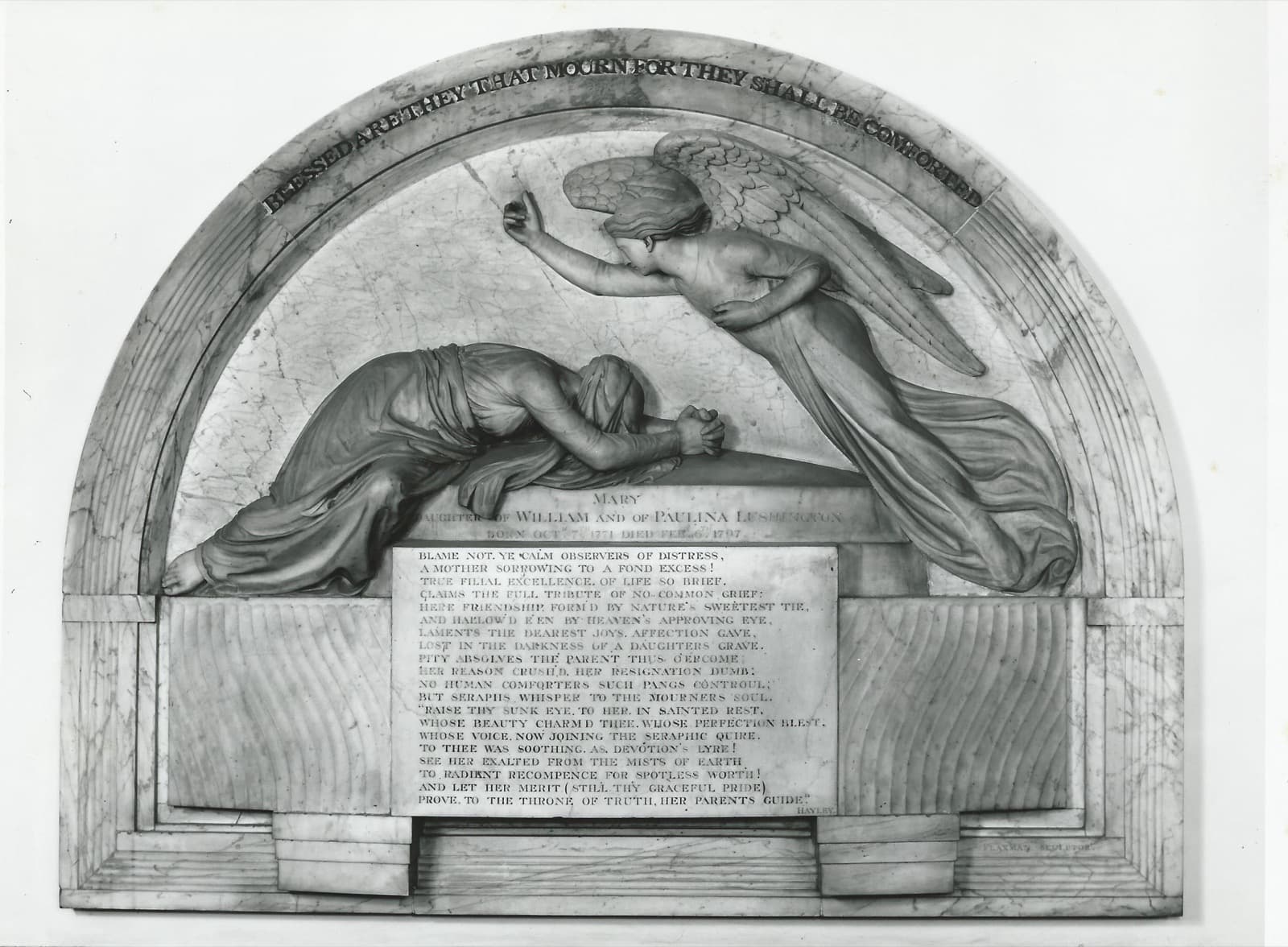
The finest thing in the building: a signed and dated work by John Flaxman R.A., 1798, in veined white and Carrara marble with lettering in bronze. A mourner lies across a sarcophagus with an angel above her. The verse is by the poet William Hayley, and her mother Paulina commissioned both; Hayley’s own son Thomas, still a boy, was fatally ill while his father wrote it. Above it, from the Beatitudes: Blessed are they that mourn, for they shall be comforted. It stood on the east wall of the nave until the chancel was built in 1880. She was married, and the monument does not say so: her married name was Blackshaw, and the Blackshaws have a tomb in this churchyard. Her parents and her husband's family were at war with each other, and the maiden name is the result — a family quarrel, settled in marble, on the best monument in the church.
Julian Watson on Mary Lushington — 1 min 54
George Stanhope
1660–1728
Nave
Vicar of Lewisham for thirty-eight years, Vicar of St Nicholas Deptford, and Dean of Canterbury from 1703. He rebuilt the vicarage at his own expense in 1692–3; it survives as Ladywell House. His epitaph is the best-written thing in the church: his learning “elegant and comprehensive”, his conversation “polite and delicate”, and “Grave without Preciseness, Facetious without Levity”.
Julian Watson on George Stanhope — 3 min
George Hattecliffe
died 1514
Brass
A brass to the son of William Hattcliffe of Catford. A later William Hatcliffe founded the Hatcliffe Almshouses; that charity and Colfe’s were later merged, and the modern almshouses stand opposite this church. The brass figure disappeared before the end of the nineteenth century and only the inscription remains.
Julian Watson on Joseph Innes and the Hattecliffe brass — 3 min 40
Ann Dick Petrie and Margaret Petrie
died 1787 and 1795
West walls of the north and south galleries
Daughter and mother, with matching monuments facing each other across the church — and two different sculptors. Ann died on 11 February 1787, aged twenty-five, in childbirth. Her monument, of about 1790 on the north side, is by Charles van Poucke of Ghent, a connection back to the abbey that was given Lewisham in 918; it shows her dying on an antique bed, her husband at the head of it raising her arm, and their children at her feet with their arms stretched out towards her. Their only son John is in the same vault, dead at seven and a half. A plaster model of the monument was shown at the first Salon in Ghent in 1792, which Van Poucke helped to run. Margaret’s, opposite, was made five years later by Thomas Banks R.A. and is signed on the pedestal of the left-hand pillar — deliberately designed to match the Fleming’s, and by the Church Record’s account based on his ideas. A photograph of it was shown at the Thomas Banks bicentenary exhibition at Sir John Soane’s Museum in 2005.
Julian Watson on the Petrie monuments — 3 min 47
Joseph Innes
died 1779
North gallery, above the doorcase
A tall memorial in marbleised imitation stone by Sanders Oliver, 1781, with an obelisk and a portrait medallion of a clean-shaven young man in profile. He died in Jamaica aged thirty-three; the inscription says he “Fell a Victim, To the Toils of Public Duty”. Our parish history makes him the nephew of William Innes of Blackheath, a leading West India merchant and Captain of the golfers there. It carries splits from water damage, and may have been harmed in the fire of 1830 which badly damaged this gallery.
Julian Watson on Joseph Innes and the Hattecliffe brass — 3 min 40
John Thackeray
1776–1851
Nave
A benefactor of Lewisham and of Christ’s Hospital, where he was at school. In 1840 he built and endowed almshouses for “six aged females”; panels at the base of his monument show the almshouses and the school. He lived at The Priory on the High Street, where a river ran along the front of the house until a sewer accidentally drained it.
Julian Watson on John Thackeray — 1 min 35
Sir Henry Watson Parker
1808–1881
West end
Youngest son of Thomas Watson Parker of Lewisham House, which stood at the corner of Ladywell Road until 1894. Sir Henry became Colonial Secretary of New South Wales.
Julian Watson on Sir Henry Watson Parker — 1 min 50
Margaret Colfe, set to music
Her memorial has had an afterlife nobody could have predicted. In 2020 the composer Lillie Harris set most of its words as Margaret, for unaccompanied choir, after coming across the inscription and feeling she had met a modern woman out of time
. It was first sung at the National Youth Choir of Great Britain’s showcase that year and is published by Stainer & Bell, who have a recording and a preview of the score.
There is more about it, and about music at St Mary’s over five centuries, on the music and the organ page.
In the churchyard
The churchyard is open every day, and the yews along the path were planted for the reason yews always were: hard wood for longbows, poisonous to cattle so useless in a field, and for early Christians a sign of everlasting life.
John Edward Gray
1800–1875
Churchyard
Keeper of Zoology at the British Museum for thirty-five years, who built the largest zoological collection in the world and published over a thousand papers, continuing after a stroke paralysed him in 1870. Our parish history records that he campaigned for slave emancipation, prison reform and public education. On 1 May 1840 he bought several Penny Blacks meaning to keep them, which makes him the first stamp collector there has ever been.
Why he matters, in a churchyard that also holds slave-owners→
The Desvignes family
1771–1910
Chest tomb on a brick vault
A French family, in England after the Revolution by way of Constantinople, and probably the most notable household in Hither Green. Peter Hubert Desvignes (1804–1883) was an architect, inventor and musician: he designed a zoetrope, entered the competition for the new Houses of Parliament in 1835, and remodelled the Liechtenstein palace in Vienna — the first Rococo Revival interior in the city, and thought the most important of its kind.
Ann Batten Cristall
1769–1848
Churchyard
A poet, born in Penzance. Her Poetical Sketches was published in 1795 by Joseph Johnson, William Blake’s publisher; reviewers criticised her technique and praised her “genius, and warmth of imagination”. Her father had “a dread of the arts”; her mother encouraged them. She and her brother Joshua, later a founder of the Society of Painters in Water Colours, walked to London and back together for their schooling. She seems to have dropped out of literary life after the 1790s and very little is known of her later years.
Henry Tibbats Stainton
1822–1892
Churchyard
Entomologist, author of The Manual of British Butterflies and Moths, and a wealthy man whose house at Mountsfield stood in its own park — now Mountsfield Park. From 1856 he held weekly open evenings there: anyone over fourteen could come in, free, to have a specimen identified or simply to learn.
Ebenezer Blackwell
died 1782
Obelisk
A partner in Martin’s Bank of Lombard Street, treasurer of this church during the rebuilding of 1774–77, and one of John Wesley’s most trusted friends from 1739 onward — called the “rough diamond” for his plain honesty. He and his wife often had Wesley to stay at The Limes on the High Street; Charles Wesley wrote funeral hymns for them both. His first wife Elizabeth, who died in 1772, is on the obelisk with him. The copper inscriptions were stolen from it in the nineteenth century and never replaced.
Alexander Rowland
d. 1823
Just inside the tower
A Lewisham barber, and the reason English has the word antimacassar. Rowland made and sold Macassar oil, a hair dressing named for the port in Sulawesi its ingredients were said to come from, and it made him rich. It also made a mess: gentlemen who used it left a greasy mark wherever they put their heads, and the drawing rooms of the nineteenth century answered with a washable cloth pinned over the back of every armchair — a cloth against the Macassar. The oil is long gone and the cloths outlived it by a century.
Ephraim How
in Lewisham from 1709
Churchyard
A cutler, and Master of the Worshipful Company of Cutlers in 1706. He and his son John came from Chingford in 1709 and built a cutlery works at Southend, the hamlet at the south end of the parish, on the water where the Homebase pond is now — a large workforce, standardised patterns and local water power, at a date when that was an unusual way to make knives. They sold from a shop on Saffron Hill by Clerkenwell. A knife and fork of ivory, silver and steel of about 1698 survives in the Victoria and Albert Museum, and the cutler’s mark of a dagger on it is probably his.
Julian Watson on Ephraim How — 1 min 3
Thomas Dermody
1775–1802
Churchyard
An Irish poet from Ennis who was, by every account including the sympathetic ones, his own worst enemy: patron after patron taken up and abused, and a death from drink at twenty-seven in squalor at Perry Slough. What happened next is the part worth knowing. The vicar, the Hon. Henry Legge, paid for the funeral himself and arranged a grand one in this church — a celebration of the life of a man who had died with nothing. The verse on the fading stone ends: “And cries, though mute, there is a poet here!”
Julian Watson on Thomas Dermody — 3 min 14
The lost brass of George Hatteclyff
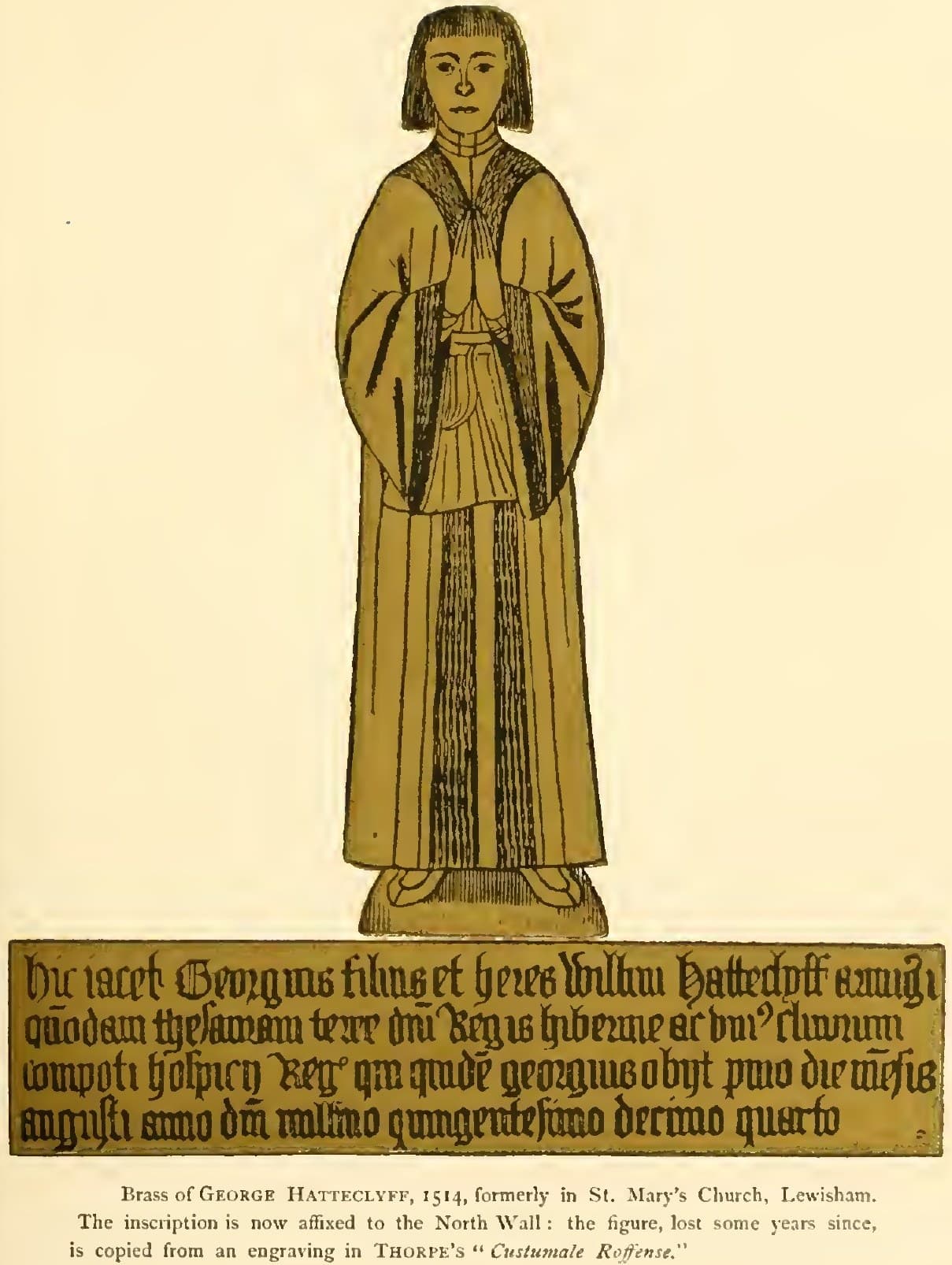
This is the only surviving likeness of it. The figure was already gone by 1892, and Leland Duncan reproduced it in his history from a drawing in Thorpe’s Custumale Roffense — a copy of a copy of a thing nobody can now see. The inscription is still on the north wall.
The churchyard itself
Until the cemetery at Brockley opened, this was the only burial ground for the whole ancient parish, and the arithmetic is startling. Burials in Elizabeth’s reign averaged thirty to forty a year and rose to a hundred in plague years. In the eighteenth century alone the registers record about seven thousand. The ground was enlarged twice, in 1791 and 1817, and closed for burials in 1856.
The oldest stone still legible in Duncan’s day was a flat slab by the wall of the south chancel: Here lyeth the body of Abraham Clowder, who departed this life the 2 day of November, 1686.
Two things stood here that have gone entirely: the parish cross, already in disrepair by 1523 when Adam Momforth left twenty pence towards a new one, and the stocks. We know where the stocks were only because of a burial entry — in February 1739 Sarah Saunders, servant to Mr Barnes, was buried “in the middle of the plat next the stocks”.
And there were two yews, each planted for somebody. A parish book records that in February 1714 a yew was set at the west end of the church, given by Mrs Soulsby of the Lyon and Lamb at the lower end of the town, in remembrance of her husband Thomas Holmes — planted by John Spencer, then clerk, and John Phillips, Sir John Lethieullier’s gardener. The other went in the March following, in remembrance of John Phillips the gardener himself, raised by him and planted by his successor according to his own will and appointment.
Both are gone, and the second was cut down in 1881 when the new chancel was built. The parish book never says where that one stood — only the first is placed at the west end — but the manner of its death answers the question. The chancel went up at the east end, so the gardener’s tree must have stood there, at the other end of the church from the one he helped to plant for Thomas Holmes the year before.
Among the tombs, Duncan singled out the How family, who owned the mill at Southend where, as their monument has it, “the art of cutlery was improv’d, and carry’d on to the greatest perfection”. It is by the north side of the tower, with the family arms cut on the top. Nearby are the tombs of two former vicars, John Inglis and William Lowth.
The registers, and a man nobody knew
The parish registers begin in 1558, but most of what survives from before 1700 does so by luck. The vestry fire of 1830 took the parochial papers and a large part of the registers with them — they were kept in an iron chest, which Duncan supposed was simply overheated until everything inside it was destroyed. From 1700 onwards, copies kept by the parish clerk fill the gap.
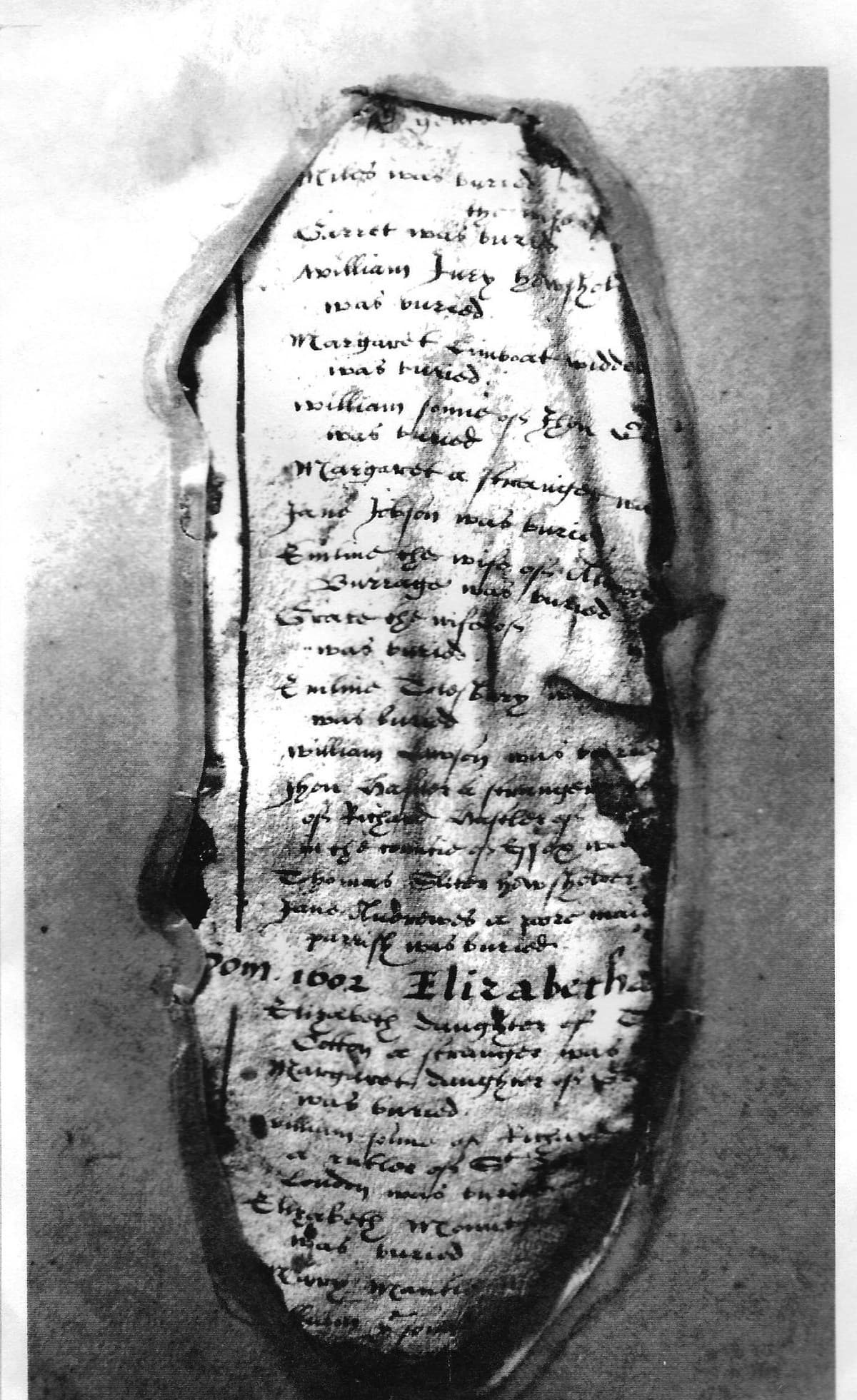
A little of it survived, shrivelled. The photograph above is a fragment of the Elizabethan registers as the fire left them, with burials of 1601 and 1602 still legible down the middle — and among the names, more than once, somebody entered simply as a stranger, and a poor maid of this parish.
One entry from the burial register of 1560 survives by a different route: the antiquary Daniel Lysons copied it out long before the fire. The parish clerk had written it as a verse.
A man nobody knew· Burial register, 12 May 1560
On the 12 day May was buried, marke that well,
a man from Pigeons of the south end
They did not him know nor where he did dwell
Charity to lodg him did me compell.
An unknown man, found at the south end of the parish and buried at the parish’s expense because there was nobody else to do it. The clerk could have written a line. He wrote four, and made them rhyme.
It survives only because the antiquary Daniel Lysons copied it out before the vestry fire of 1830 destroyed most of the early registers.
It is the oldest thing on this site written by somebody who worked here — older than any monument in the building, and about somebody who could not have afforded one.
Under the floor
There is a third set of memorials here that no visitor sees. The crypt runs under the church in brick barrel vaults, and families bought space in it: the stones set into the walls are not gravestones but statements of ownership, cut for the living.
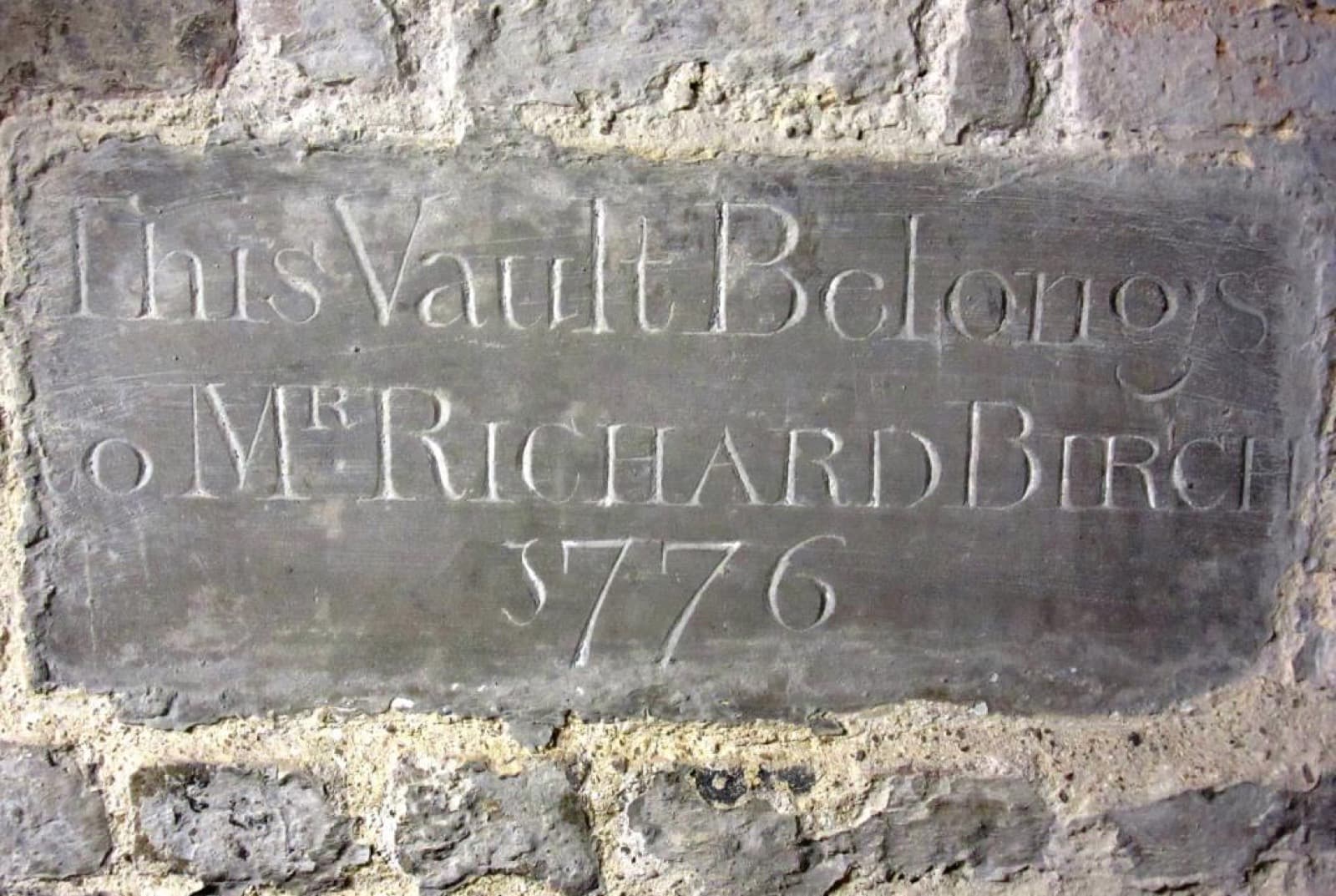
This Vault Belongs to Mr Richard Birch 1776 — cut, plainly and confidently, while the church above it was still a building site. The medieval church had come down in 1774 and the new one did not open until 1777. Nothing else here records who he was.
The crypt is closed and stays closed. It is a burial place, not a room, and the only part of it in use is the meeting room let at the east end — see room and venue hire.
Two things almost nobody looks at
A. J. French, vicar’s warden from 1921, wrote a short guide to the church and put two survivals in it that are not monuments at all and are easy to walk past.
The shelf over the north door. The churchwardens’ pew stood on the north side in the Georgian church, and French records that the shelf above the door was where the loaves were put — bread distributed every week by the churchwardens to the poor of the parish. The pew has gone. The shelf, he says, is still there.
The sounding board in the south porch. The Georgian church had a three-decker: clerk’s box, reading pew and pulpit stacked one above another, with a canopy over the preacher’s head to throw his voice down the nave. The three-decker went in the alterations of 1881. French reports the sounding board off the top of it as still in the south porch.
Both are French’s account, written a century ago, and neither has been checked against the building for this page. If you are in the church and can confirm or contradict either, the parish office would like to know.
Seeing them
There is a heritage trail through the church and churchyard with audio commentaries recorded by Julian Watson. The church is open when somebody can be here to keep it open — visiting us says when that is, and the churchyard is open every day.
Elsewhere on this site
Several of these people have a page of their own elsewhere. Every vicar commemorated here is in the full list on the vicars of Lewisham, and the house George Stanhope rebuilt at his own expense — still standing as Ladywell House — is on the vicarage. Margaret Colfe’s husband Abraham founded the grammar school, the reading school, the library and the almshouses that are still running, on the schools and the almshouses.
George Hattecliffe’s brass of 1514 is nearly the last thing left from the church that stood here before this one — a building of chantry priests, guild lights and painted images, reconstructed from wills on the medieval parish.
Two of these belong with the parish plate, which is on loan to the Victoria and Albert Museum and described on the church silver: Ephraim How’s dagger mark is on a knife and fork in the same museum, and the fire of 1830 that may have damaged the Innes memorial is the fire the communion plate was carried out of. Ebenezer Blackwell kept the accounts for the rebuilding that produced the galleries most of these monuments hang in — on the history pages.
Where this comes from
This parish is fortunate in its historians. Three works stand behind these pages, and none of them is ours.
St Mary's Church Lewisham: History (2004, revised 2017)
Julian Watson
Copyright Julian Watson, used with his permission. The greater part of what is written here comes from this book and from his unpublished research, and any of it that is wrong is our doing rather than his.
The Churchyard of St Mary the Virgin, Lewisham (1992)
Ken White
Copyright Ken White, used with his permission.
The Church Record of St Mary the Virgin, Lewisham
The Arts Society Blackheath and The Arts Society Greenwich, completed by the Church Recording Society, 2021–2024
A catalogue of every object in the building, begun in the incumbency of Canon David Garlick and finished in that of Fr Steve Hall. The descriptions, measurements and attributions of the monuments come from it.
The Parish Church of Saint Mary, Lewisham, Kent (1892)
Leland L. Duncan, F.S.A.
Out of copyright, so this is a citation rather than a licence — but it is the single largest source for the medieval parish, the tower bequests, the churchyard, the vicarage house and the medieval vicars, and its six plates are the earliest images the parish has. Duncan was honorary secretary of the Lewisham Antiquarian Society, which met in the parish church hall, and he was educated at Colfe's — the school one of these vicars founded.
Some of these captions are guesses. Please correct us.
The parish archive runs to well over a thousand photographs, most of them unlabelled. Where a caption here rests on a filename rather than on a document, it says so — but we will have got things wrong that we do not yet know are wrong.
If you recognise a place, a face, a date or an object, we would be very glad to hear from you, and we will change the page and say who told us. Photographs of the church before the 1990s re-ordering, and anything at all of the choir, would be especially welcome.
Text and images are the copyright of their authors unless otherwise stated. If you would like to reproduce anything from these pages, please ask us and we will put you in touch with the right person.