History & Heritage
Music and the organ
A parishioner left money for a 'payre of organys' in 1521. There has been music here ever since, and five organs to make it on.
Music is the thing this church has spent the most money on, over the longest period, with the least to show for it afterwards — four of its five organs are gone. What survives is the habit: a choir, a tradition of singing the mass, and a choral society founded here that outgrew the parish.
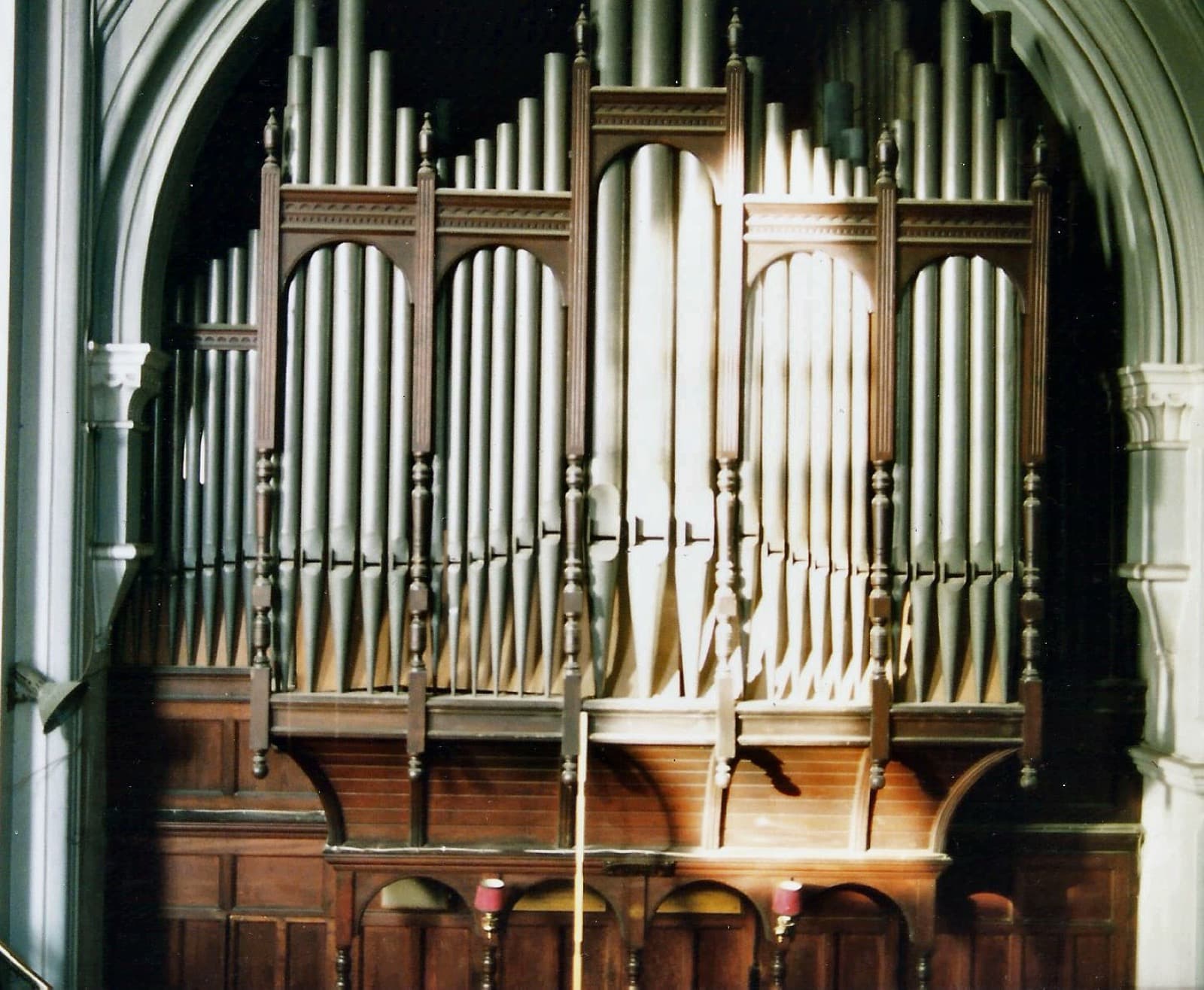
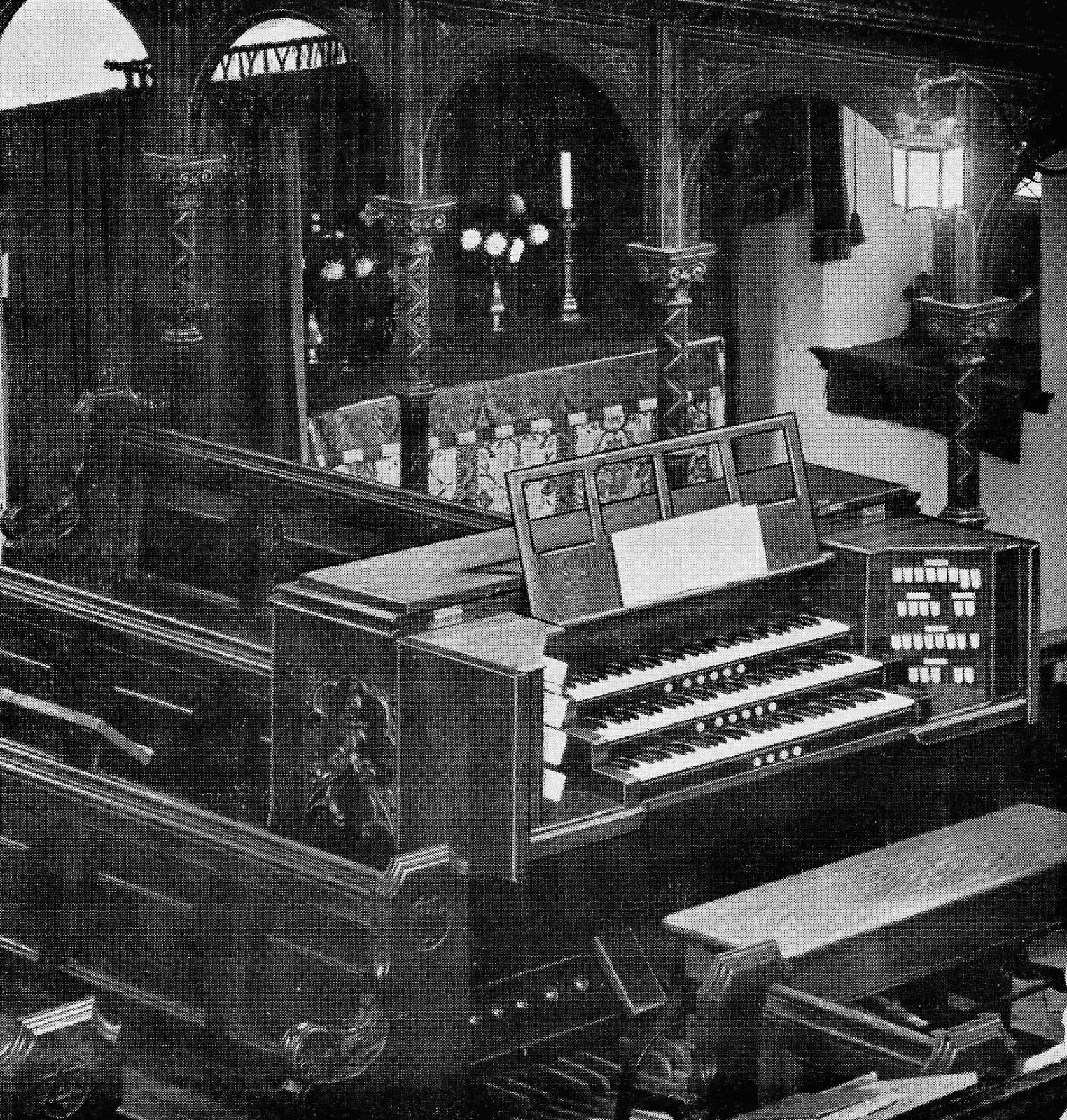
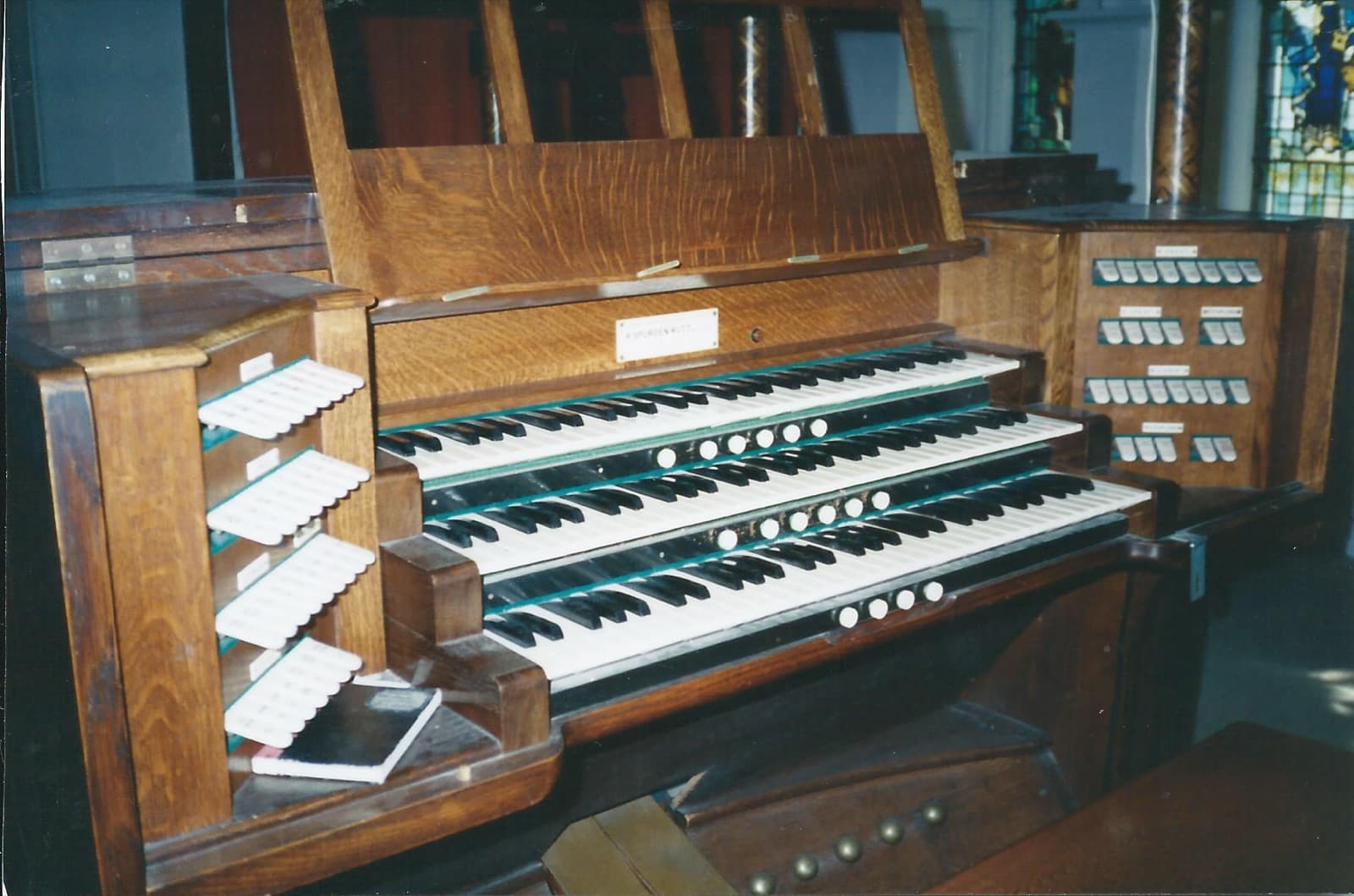
Whitsun 1882
The new organ was opened with a week of it. Special Whitsuntide services, a preacher borrowed from Deptford on Whitsun Eve and another from Holy Trinity, Lee, on the day itself, communion at seven, eight and half past twelve, a Service of Song for Children at half past three — and an organ recital after Evensong every day.
The first was on Saturday 27 May 1882, played by C. Warwick Jordan, organist of St Stephen’s, Lewisham — a daughter parish opening the mother church’s organ, and slipping one of his own compositions in at number two. He finished with Bach and, at number six, gave them Sullivan’s The Lost Chord, which was five years old and the most famous song in England.
On Whit Sunday the parish’s own organist G. W. Baker had his turn: Mendelssohn, two pieces by Henry Smart, and a Bach prelude and fugue to end.
That printed date is why this page says 1882. It had said 1913, on the strength of a tender that turns out to be for later work on an organ already standing.
There were four in all. On the Monday came W. J. Westbrook, Mus.Doc., organist of St Bartholomew’s, Sydenham, opening with a festival march of his own; on the Tuesday E. G. Meers, Mus.Bac., with Schubert’s Ave Maria, Mendelssohn, Meyerbeer and a march called Abraham. Westbrook also played The Lost Chord — which means Lewisham heard the most famous song in England twice on the same new organ inside three days, from two different players, and nobody appears to have minded.
The instrument they were opening had thirty-five speaking stops over Great, Swell, Choir and Pedal, with seven couplers and a tremulant. The Great ran from a sixteen-foot Bourdon up through a Full Mixture of five ranks to a Posaune and a Clarion; the Swell had a Vox Humana and a Voix Celeste; the Choir a Clarionet and Bassoon; the Pedal a Trombone at sixteen foot. Seventy years later Spurden Rutt would divide and enlarge it to forty-four, and the Allen that replaced the whole thing in 1994 has forty-five.
Why Isobel Baillie came to Lewisham
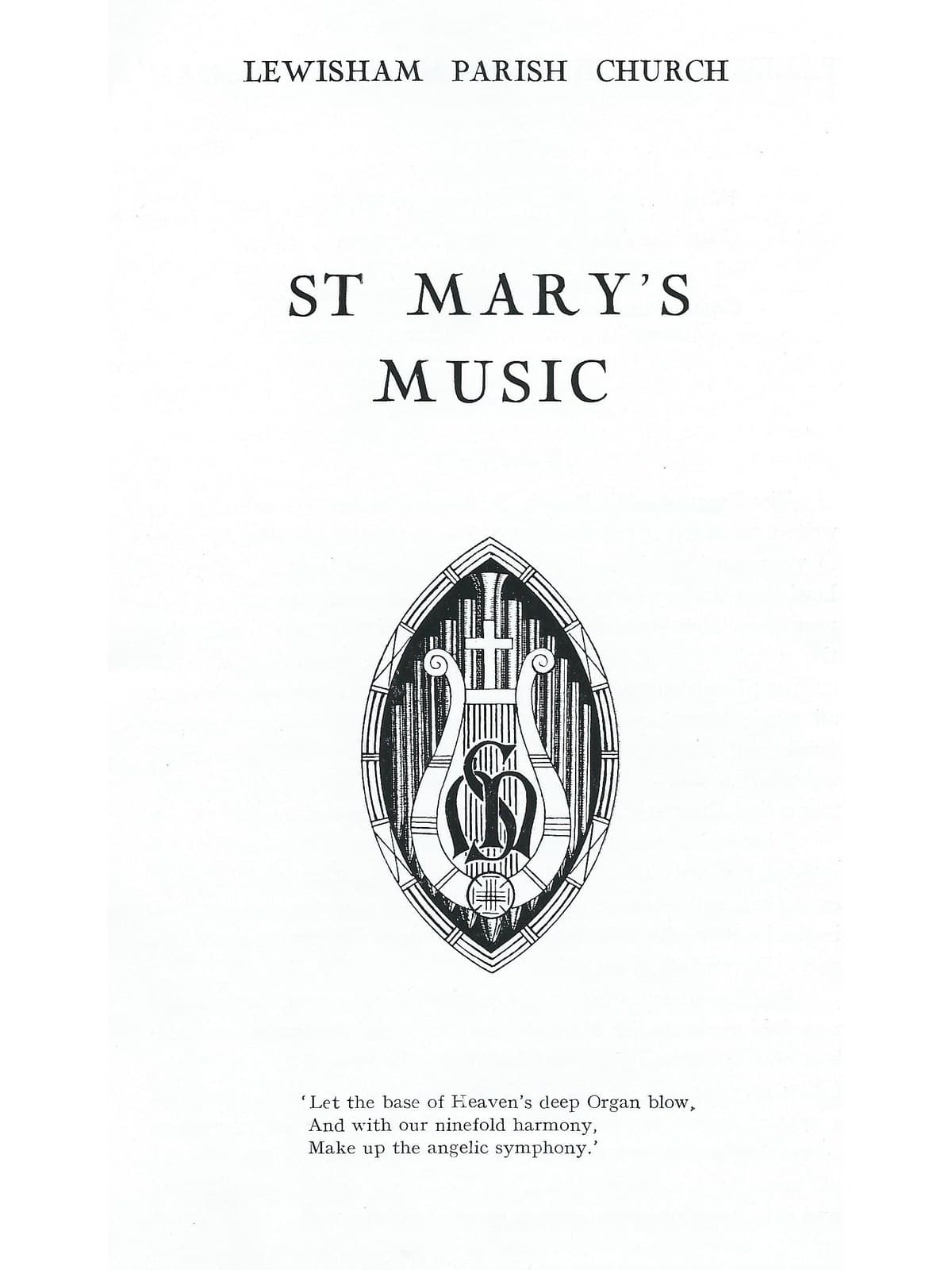
In July 1951 the parish printed a sixpenny booklet called St Mary’s Music, with a lyre and organ pipes on the cover and three lines of Milton under them. Its purpose, it said, was twofold: to further the interests of music in the Borough of Lewisham, and secondly it is in the nature of an appeal.
The organ was in a bad state. Nothing major had been done to it since 1882 and it was still running on its original action. So the parish put on a programme of concerts from July to December, some eminent soloists have already promised to assist us — with a retiring silver collection at each for the Organ Rebuilding Fund, and no charge and no tickets for admission. Donations to the treasurer, Mr J. A. Musto MBE of Albacore Crescent, or the box by the south door.
That is the answer to a question this page raises and could not previously answer. The recitals above are not a parish that happened to know famous musicians. They are a fundraising campaign, and it worked: the rebuilt organ was dedicated in December 1952.
What they did to Milton
Under the device on that cover are three lines from Milton’s On the Morning of Christ’s Nativity, where the poet calls on the spheres to sound and the angels to sing. Milton wrote: And let the Base of Heav’ns deep Organ blow, and with your ninefold harmony make up full consort to th’Angelike symphony.
The parish printed and with our ninefold harmony, make up the angelic symphony. One letter, and the choir of a Lewisham parish church stops listening to the angels and joins in. Whether that was a decision or a compositor is not recorded, and it is a good motto either way.
The register, 1956
The parish still has a choir attendance book from 1956, ruled in blue ink and marked service by service. It is divided the way a choir is divided rather than by voice: Decani on one side and Cantoris on the other — the two halves that face each other across a chancel and sing to one another, named for the side the dean sits on and the side the cantor does. Twenty-two names between them.
It is a book about families as much as about music. There are two Deversons, two Rickwoods and two Miltons in it — brothers in the same choir, on opposite sides of the aisle — and the attendance marks run in unbroken columns for weeks at a time.
And a name in the Cantoris column is worth a second look. Christopher Stringfellow sang here as a boy in 1956. A Chris Stringfellow appears in the list of this church’s directors of music above, and conducted the combined choirs of St Augustine’s and St Mary’s when Desmond Tutu was made a Freeman of the Borough in 1990. Thirty-four years is exactly the right interval for a boy chorister to become the man in front of the choir, and they are the same person — confirmed by David on 21 August 2026, in the website window. The boy in the Cantoris column came back to stand in front of the choir he had sung in.
And he has not stopped. His birthday in September 2026 marks his seventieth year of continuous involvement with this church — from the boy signed into the Cantoris column in 1956 to the man who was later charged with the old organ, helped choose the one that replaced it, and conducted the choir for Desmond Tutu. No vicar has ever held this living that long. The record is William Lowth’s fifty-five years, and it is on the vicars of Lewisham.
The choir in 1951
The same booklet describes the choir. William Whitehead, organist and choirmaster from 1900 to 1950, had died the year before, and Lewis Vincent had taken over. Between two of the choir’s members there were more than a hundred years of service.
And the anxiety is the one every parish choir still has: it is difficult to recruit boy choristers these days in face of so many conflicting interests. They were fortunate, they said, in St Mary’s School and a few local teachers. Then the sentence that could be written this morning: the boy chorister should be encouraged in every way possible as he is the adult chorister of to-morrow, and without him the future of the choir is in very real danger.
The booklet also dates something precisely. The St Mary’s Singers were formed in October 1950, to sing music outside the ordinary duties of the choir, and already had about forty men and women in them.
Canon P. D. Robb wrote the foreword. St Mary’s, he said, is the ancient mother church of Lewisham and should take a lead in all activities which promote a high standard of Church worship and forge a link with the cultural life of the Borough — and he hoped the booklet would interest people well beyond anyone who worshipped anywhere, all in the locality who look on music as one of the great possessions and achievements of mankind.
What they sang when the new organ came
Easter Day 1996, Choral Evensong, the Bishop of Woolwich officiating. The order of service survives and the choosing of it is the good part: Bach to open, the Gloria from Mozart’s Mass in C as the choir came in, Walmisley in D for the canticles — and then three things that are all, unmistakably, about instruments.
The entrance hymn was Angel-voices ever singing, which is the hymn the Church of England reaches for when it is dedicating something, and which contains the line Craftsman’s art and music’s measure. The psalm was 150, set by Stanford — the psalm that is nothing but a list of instruments, from the trumpet and the lute to the loud cymbals. And the anthem was from Britten’s Rejoice in the Lamb, setting Christopher Smart:
For the trumpet of God is a blessed intelligence and so are all the instruments in heaven. For God the Father Almighty plays upon the harp of stupendous magnitude and melody.
Smart wrote that in an asylum in the 1760s. It was sung here in 1996 by a parish that had just lost the fourth of its five organs and was blessing the machine that replaced it — and the next line of it is at that time malignity ceases and the devils themselves are at peace.
What it could do
The 1952 specification is worth a moment for the names alone. Beside the diapasons and the mixtures the parish had a Vox Humana and a Celeste, a Flauto Traverso and a Lieblich Gedeckt, a Contra Fagotto at sixteen foot and a Trombone on the pedals. The Choir organ’s Tromba was borrowed from the Great and left unenclosed, which is an organ builder’s way of saying there was not room for everything.
The booklet names the vicar as Canon P. D. Robb and the musical director as Lewis Vincent, and the builders as R. Spurden Rutt & Co. of Leyton, E.10.
The organs, in order
- 1521
A payre of organys
Stephen Colman left the residue of his goods towards buying one. It appears in the inventory of church goods in 1552, so it was still there thirty years later — and survived the Reformation, which many did not.
- c.1790
Samuel Spencer's instrument
When the medieval church was taken down in 1774 arrangements were made for the old organ's safe custody. Samuel Spencer then presented a much larger one, which stood in the western gallery.
- 19th century
The subscription organ
Raised by public subscription and put in the same western gallery as its two predecessors. It went in 1881, when the gallery itself was removed in the Victorian remodelling.
- 1881–82
Brindley and Foster
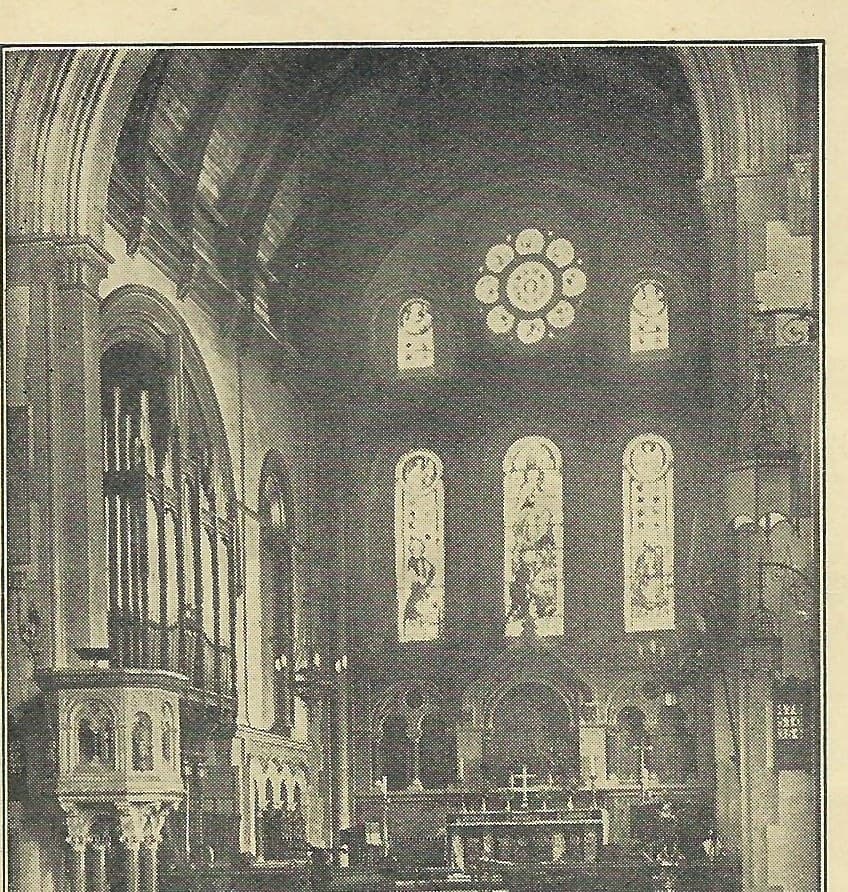
The parish decided to buy it rather than move what it had. A congregational resolution of March 1881 sent a committee two questions: whether the organ then in the Western Gallery could be safely and advantageously moved to the place prepared for it in the new chancel, or whether it would be “cheaper and better to erect a new one in its place”. Five authorities were consulted and were unanimous that the old instrument was not worth removing. The appeal went out from the vestry on 6 October 1881, costing the new organ at about £800, of which £330 5s had already been promised — the largest gifts £100 from E. Tidswell of Springfield, Catford, the fund’s honorary treasurer, and £40 from H. T. Stainton, the entomologist of Mountsfield, who is buried in the churchyard. The result was a three-manual organ by Brindley and Foster of Sheffield, in the north transept of the chancel the Earl of Dartmouth had just built. It was opened over Whitsuntide — the first recital was on Saturday 27 May 1882 — with the offertories at every service that week “devoted to the expenses of erecting the Organ”. In 1951 the parish believed it to be “one of their few remaining original instruments”, and recorded that no major repair had been done since and that the original action was still in use, sixty-nine years on. A. J. French, vicar's warden from 1921, was not entirely satisfied with where it sat: it “suffers like so many organs which are in chancels from its position, the full sound of some of its pipes being somewhat stifled by the chancel arch”.
- 1913
Work on it, for £150
A tender survives, dated 26 June 1913 and signed by the firm: Brindley and Foster “hereby agree to carry out in an able and satisfactory manner all the work described in the accompanying specification and estimate for the net sum of £150:0:0”. What the work was is not known — the specification was a separate sheet, to be returned to Sheffield undamaged if the offer was refused, and it is not with the tender. The wording is “relating to the Organ in” the parish church rather than for a new one.
- 1952
Spurden Rutt
The Brindley and Foster was divided and enlarged by R. Spurden Rutt & Co and given a three-manual console with electro-pneumatic action — answering French's complaint of forty years earlier by putting pipes on both sides of the chancel. It was dedicated at the Sung Eucharist on Sunday 14 December 1952, with a recital that evening by the choir and Lewis Vincent. The booklet printed for it survives, with the full specification: forty-four speaking stops over three manuals and pedals, a new detached oak console with ivory keyboards, and stop-key control with double-touch cancelling.
- 1983–97
The pipe organ goes
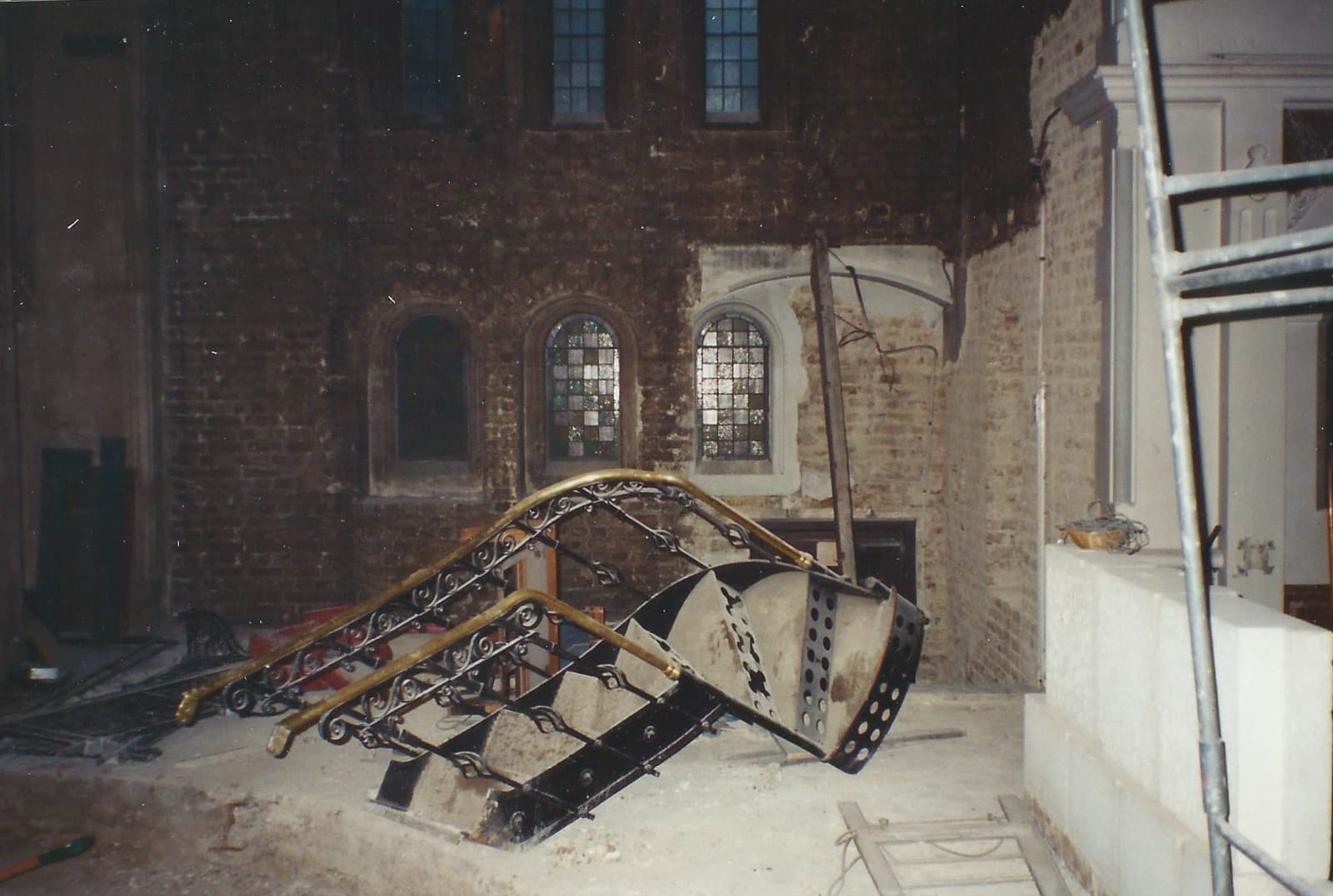
A fourteen-year decline, documented the whole way by Chris Stringfellow, who became director of music in 1983 and told the PCC that year that a thirty-year-old organ was going to cost money. In 1984 E. J. Johnson & Son quoted £5,000 to clean and restore it; by 1987 Martin Cross quoted £50,000 for the same work and £100,000 for a new pipe organ, and N. P. Mander reported that the instrument had “reached the end of its useful working life”. Dust, dirt and nesting material went on falling into the pipes. By February 1993 water damage had taken out a whole section and forty per cent of the organ was unplayable. It was taken out during the re-ordering, and in June 1997 the Diocesan Advisory Committee certified it redundant and told the parish to advertise it for eighteen months on the British Institute of Organ Studies’ register of redundant organs before the pipework could be sold for parts. It is the fourth instrument this church has lost, and the only one whose going was written down at the time.
- 1994–96
The Allen digital organ
An Allen MDS-40-S: three manuals, forty-five speaking stops with no unification, a walnut drawknob console, and the speakers hidden at gallery floor level in the second bay from the chancel arch, angled off the walls and the ceiling so that nothing unsightly could be seen. It cost £25,995 — a £10,000 deposit and £15,995 on installation. It arrived earlier than the page used to say: Allen unpacked it after Easter 1994 and installed it on Friday 13 May that year, before the faculty had been granted and therefore on a temporary footing. The blessing came two years later, at Choral Evensong on Easter Day, 7 April 1996, by Peter, Bishop of Woolwich, five weeks after the new altar and sanctuary were consecrated by the Archbishop of York. The order of service survives, and whoever chose the music chose it well: every substantial item in it is about instruments.
How the present organ was chosen
In October 1993 somebody sat down and wrote a report comparing seven pipeless organ companies and one traditional organ builder. It survives, and it is a model of how to make a decision.
Four criteria: a three-manual draw stop action, the best quality of sound, the best quality of components and workmanship, and suitability for use at St Mary’s. The first of those set the price — “knowing our financial situation, it was decided to make the upper limit about £25,000”.
Then they listened to all of them and wrote down what they thought. Copeman Hart was “superb but perhaps too continental”. Makin gave “a very electronic sound”. Bradford was “badly balanced, with an inappropriate heavy Cathedral type sound”. Cathedral produced “a very good Romantic English sound” but was weak in the trumpet reeds. Allen was “slightly more classical in style” and gave, in a phrase worth keeping, a “living” sound.
And then this, in a bracket, as though it were a small matter:
“It is expected that the new organ will be with us for many years (until we have found the funds for a suitable pipe organ).”
That was written in 1993. The funds have not yet been found.
From St Mary’s Lewisham Organ Report, October 1993, in the parish archive.
Those who have directed it
- 1800s
G. W. Baker, F. Atkinson and Frederick Leeds
Three successive organists through the later nineteenth century. Baker's initials come from the programme for the opening of the organ in 1882, where he is “Organist of the Parish Church” — the parish's own list had read “Gee Baker”, which is how a G. gets transcribed twice.
- 1900–1950
William Whitehead
Previously deputy organist at Southwark Cathedral. Fifty or so singers under him — a photograph of the choir in 1907 survives.
- 1950–
Lewis Vincent
Founded the St Mary's Singers, which became the Lewisham Choral Society and sings still.
- to 1983
Colin Howard, then David Kemp
Between Lewis Vincent and 1983, in that order. Neither man's dates are established yet — the only fixed point is that Chris Stringfellow followed Kemp.
- 1983–2020
Chris Stringfellow
Thirty-seven years, broken only by a single year out — second only to William Whitehead's fifty. He had sung in this choir as a boy in 1956, which makes him the only person on this list who was in the choir before he was in charge of it.
- date unknown
Jonathan Pease
A director of the choir rather than an organist, but where he falls in the sequence is not yet established.
- 2020–
Laurence Padfield, then Chris Weeks
Appointed as Chris Stringfellow stepped back.
And separately, the organists. Chris Eva, James Thomas, Richard Baker were appointed to play rather than to direct the choir. They appear in the parish’s older list run together with the directors, which is what made that list look out of order; Richard Baker is not in it at all. Dates for all three are still to be established.
The recitals of the 1950s
For a few years in the middle of the last century this parish church ran a celebrity recital series, and the programmes survive.
- 29 January 1953Dr John Dykes BowerOrganist of St Paul's Cathedral
- 19 February 1953John MeuxOrgan recital
- 3 February 1953Nancy EvansMezzo-soprano, with St Mary's choristers
- 14 January 1954Isobel BaillieSoprano, with St Mary's choristers
- 23 May 1957Alfred Deller and Desmond DupréCounter-tenor and lute, with the choristers. Programme sixpence.
All of them under Lewis Vincent, who had arrived in 1950 and who founded the St Mary’s Singers. Isobel Baillie and Alfred Deller were among the best-known singers in the country at the time. They came to a parish church on Lewisham High Street, on a Thursday evening, to sing with the local choirboys.
What the boys were told they were doing
In 1907 — the year of the surviving choir photograph — A. P. Gutch, an assistant priest of this parish, published a small book with A. R. Mowbray of London and Oxford. It is called My Father’s House: Words to Choir Boys, and the title page identifies him simply as Assistant Priest, S. Mary’s, Lewisham, S.E. He was here for eleven years, from 1900 to 1911, and afterwards joined the Community of St Denis at Warminster.
It opens by telling a boy what he is:
God has called you to a special work in His Holy Church. You are to be a “singer of the sanctuary.” Yours is an important ministry, and to be carried out just as carefully as the ministry of priest, server, or organist.
Then one rule, in capitals: BE REVERENT — explained to a child by way of Jacob waking at the foot of the ladder and Moses taking off his shoes at the bush. A boy in a surplice on a Sunday morning in Lewisham is being told he is standing on the same ground.
The copy the parish holds was somebody’s. Inside the front cover, in a careful hand: Charles Taylor, admitted to S. Mary’s Choir, Lewisham, Aug 3 1917. He was given a ten-year-old book on the day he joined, in the fourth summer of the First World War, and it is still here.
A second copy survives — Chris Stringfellow has one, given to him not as a boy but by an elderly member of this choir, who passed it on. For a day this page suggested that meant the parish inscribed a copy for every boy it admitted. It does not: a book that changes hands twice in seventy years is a book being handed down, not a practice. Charles Taylor’s name is still the only one either copy carries.
The choir goes to Southwark, 1900
On the evening of Thursday 31 May 1900 the choir sang at the South London Choirs Festival in St Saviour’s Collegiate Church, Southwark — St Mary Overie, which would become Southwark Cathedral five years later.
Singers came from twelve churches: St Saviour’s itself, and Wandsworth, Sydenham, Southwark, Clapham, Battersea, Norwood, Balham, Putney, Walworth, Streatham — and Lewisham. St Bartholomew, Sydenham, was there too, which is worth noticing: the first parish carved out of this one, singing beside its mother church. A. Madeley Richardson conducted, and there was an organ recital at a quarter to seven — Piutti, Widor and F. E. Gladstone.
The parish’s copy of the programme is the choir’s own. It carries a rubber stamp reading Parish Church of St Mary, Lewisham — Choir and the number 6 in pencil in the corner, because a choir library is a numbered set of copies that has to come back.
Colin Howard
One name in the list of directors of music above has a fuller story than the list can hold. Colin Montgomery Howard, 1945–2008, was a Cape Town musician: educated at Harold Cressy High School, taught the organ as a boy by the City Organist and the piano by the director of music at Bishop’s, and brought to London by scholarships to the Royal College of Music. He came away with GRSM, ARCM and FRCO — a Fellow of the Royal College of Organists, which is as far as that examination goes — and later a master’s in ethnomusicology from London.
He was Director of Music at Colfe’s for eighteen years, which is how a Cape Town organist comes to be woven into the history of a Lewisham parish church. His chamber choir toured Germany, France and half a dozen American cities; his combined choirs sang Bach’s St Matthew Passion and Verdi’s Requiem at the Royal Albert Hall with professional soloists, and worked regularly with the BBC.
Two of those years are worth putting side by side. In 1990 he conducted Colfe’s choir when Lewisham made Desmond Tutu a Freeman of the Borough. In 1996 he took the same forces to South Africa, to sing in Cape Town and Johannesburg.
He retired to Cape Town, coached singers at the university, and was organist and director of music at Christ Church, Constantia. The memorial service was held here on 27 September 2008.
Two organ committees, a hundred and twelve years apart
The parish has chosen an organ twice, and both times it did the work itself rather than taking the first advice offered. The papers for both survive, the second set kept by the man who chaired it.
The first met in the vestry on Wednesday 11 May 1881, with the vicar — Augustus Legge, later Bishop of Lichfield — in the chair. E. Tidswell was made honorary treasurer and G. W. J. King honorary secretary, an account was opened at the Lewisham branch of the London and Provincial Bank in their joint names, and the organist G. W. Baker was asked, with the Revd M. Mitchell Connor, to draw up a specification. Among those present was L. C. Duncan, whose son Leland was then eighteen and would spend his life on the history of this parish — Leland Duncan.
Then they wrote to five organ builders — Brindley & Foster, B. Flight & Son, Holdich, Willis & Son, and Lewis — with three questions: whether the organ then in use could sensibly be adapted to the organ chamber in the new chancel, what a new one would cost, and what allowance would be made for the old one in part exchange.
That closes a loop this page had left open. The printed appeal of the following October says that five competent authorities were consulted and were unanimous that the old instrument was not worth removing — and never says who they were. They were those five firms, two of them, Willis and Lewis, among the greatest English builders of the century. The parish put the question to the trade and took the answer.
The second committee reported in October 1993 and did exactly the same thing on a larger scale: offers from seven makers of pipeless organs and one traditional builder, judged against four criteria settled in advance, with several instruments demonstrated in the building. The costings ran from £125,000 to rebuild what they had, through a restored two-manual Father Willis at £77,240, down to £19,480. Some were rejected on sound — one was “badly balanced, with inappropriate heavy sounding bass notes”, another “perhaps too baroque”. The Allen was chosen at £25,995 because it gave, in the committee’s words, a living presence due to a more comprehensive voicing system — and because, unusually, the congregation was asked and most of those who offered an opinion preferred it.
One decision from that report is still standing in the building. To house the speakers, the committee proposed moving the casing of the old Brindley and Foster into the gallery and making of it a “false organ” — a shell with nothing behind it. The pipes went for parts; the front of the organ this parish spent 1881 choosing may still be there.
The wider musical life
The parish has commissioned music about itself. The Vixen of Ladywell is a cantata for soloists, choir and woodwind ensemble by David Moses, written for St Mary’s and telling the history of the church and of Ladywell — the holy well, the parish, and the ground these pages are about, sung by the people who stand on it. It can be heard here. The parish does not yet have a date for the first performance.
Music here has never been only the choir. In 1957 the counter-tenor Alfred Deller sang here with Desmond Dupré and the choir — Deller then at the height of a career that more or less re-invented the counter-tenor voice in England.
Desmond Tutu was given the Freedom of the Borough of Lewisham in 1990 — at Goldsmiths’, not here. But he had already lived in the borough: from 1972 to 1975 the Tutus had a house on Chinbrook Road, he spent his weekends as honorary curate of St Augustine’s, Grove Park, and his son Trevor was at Colfe’s — the school a Vicar of Lewisham founded.
And he did come to St Mary’s. Julian Watson — who was there — records a visit by Tutu to St Mary’s School and to this church, and calls it a truly amazing occasion. The parish archive has the photograph.
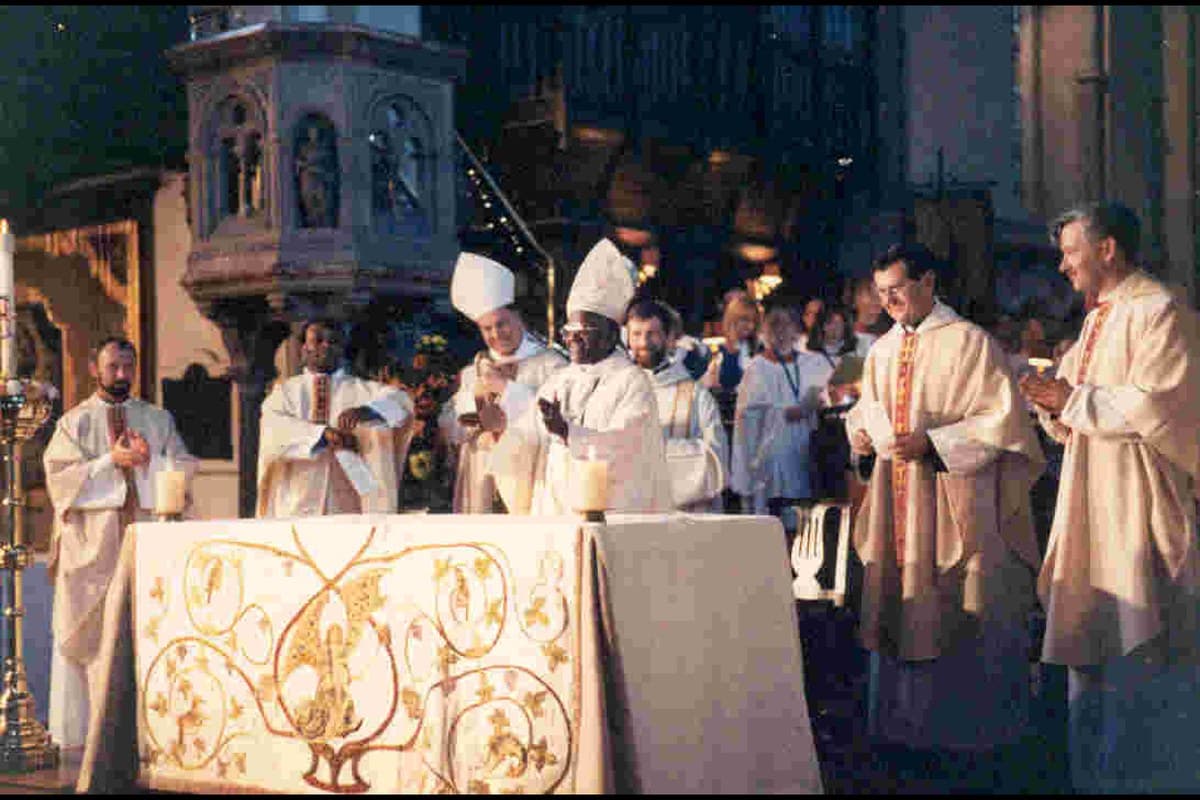
Some of this can be watched rather than read about. The parish keeps a YouTube channel, which carries the Sunday live stream and, increasingly, the archive: concerts, workshops and occasions going back years, put there by Chris Stringfellow.
The parish had a part in the Goldsmiths’ ceremony too, which the correction above had obscured. The order of proceedings for 4 May 1990 has the choirs of St Augustine’s Grove Park, St Mary’s Lewisham and Colfe’s School singing the African chant Freedom is Coming together, and the choirs of St Augustine’s and St Mary’s singing Rejoice in the Lord alway under Chris Stringfellow. Colfe’s choir performed a piece by Stanley Glasser under Colin Howard. Both men are on the list of this church’s directors of music above.
Both survive as recordings on the parish’s channel, put there by Chris Stringfellow in 2026: the ceremony itself, and Glasser’s The Drought.
The council had resolved on it the previous November, admitting him for his work while he was Honorary Curate at St Augustine’s Grove Park. Trevor Huddleston spoke in support of the resolution, and so did Paul Boateng, then the local member of parliament. They ended with Nkosi Sikelel’ iAfrika.
A memorial here, set to music
In 2020 the composer Lillie Harris wrote Margaret, for unaccompanied SATB choir, taking most of its text from a seventeenth-century memorial in this church — the one to Margaret Colfe, the parish midwife who worked over forty years without payment and was buried here in 1643.
Harris added three words of her own, meadow-dwelling medica: a play on the old meaning of Lewisham, the dwelling in the meadows, and medica, a woman doctor, borrowed from the thirteenth-century deeds of Leominster. She describes finding the inscription and feeling she had met a modern woman out of time
— ordinary and remarkable at once, and a seventeenth-century woman practising medicine.
It was first performed at the National Youth Choir of Great Britain’s showcase in early 2020, when Harris was one of four composers on the choir’s Young Composers Scheme, and it is published by Stainer & Bell. There is a recording, and the score can be previewed, on the publisher’s page.
Almost nothing is known of Margaret Colfe beyond what the stone says, and it survives at all because her second husband was the vicar. That a stranger read it four centuries later and wrote a piece of music about her is the best argument this page can make for keeping such things legible.
Singing here now
The choir sings at the Sunday Sung Mass and at Choral Evensong. If you would like to sing, see music at St Mary’s — you do not have to read music and you do not have to audition.
Elsewhere on this site
The first organ on this page arrived the way everything in the pre-Reformation church arrived: Stephen Colman left the residue of his goods towards buying one in 1521, unless the churchwardens could think of something better to do with the money. The parish that fitted itself out by will — organs, banners, a widow’s crimson kirtle cut up into a vestment — is on the medieval parish.
The last organ on it arrived by a different route. The pipe organ came out in the re-ordering of 1995–96, which freed the old sanctuary to become the chapel of St Peter; that work is on the history pages.
Where this comes from
This parish is fortunate in its historians. Three works stand behind these pages, and none of them is ours.
St Mary's Church Lewisham: History (2004, revised 2017)
Julian Watson
Copyright Julian Watson, used with his permission. The greater part of what is written here comes from this book and from his unpublished research, and any of it that is wrong is our doing rather than his.
The Churchyard of St Mary the Virgin, Lewisham (1992)
Ken White
Copyright Ken White, used with his permission.
The Church Record of St Mary the Virgin, Lewisham
The Arts Society Blackheath and The Arts Society Greenwich, completed by the Church Recording Society, 2021–2024
A catalogue of every object in the building, begun in the incumbency of Canon David Garlick and finished in that of Fr Steve Hall. The descriptions, measurements and attributions of the monuments come from it.
The Parish Church of Saint Mary, Lewisham, Kent (1892)
Leland L. Duncan, F.S.A.
Out of copyright, so this is a citation rather than a licence — but it is the single largest source for the medieval parish, the tower bequests, the churchyard, the vicarage house and the medieval vicars, and its six plates are the earliest images the parish has. Duncan was honorary secretary of the Lewisham Antiquarian Society, which met in the parish church hall, and he was educated at Colfe's — the school one of these vicars founded.
Some of these captions are guesses. Please correct us.
The parish archive runs to well over a thousand photographs, most of them unlabelled. Where a caption here rests on a filename rather than on a document, it says so — but we will have got things wrong that we do not yet know are wrong.
If you recognise a place, a face, a date or an object, we would be very glad to hear from you, and we will change the page and say who told us. Photographs of the church before the 1990s re-ordering, and anything at all of the choir, would be especially welcome.
Text and images are the copyright of their authors unless otherwise stated. If you would like to reproduce anything from these pages, please ask us and we will put you in touch with the right person.