History & Heritage
The medieval parish
Before the Reformation this was a building full of candles, colour and paid prayer. Almost everything we know about it comes from people saying, as they died, what they wanted done with their money.
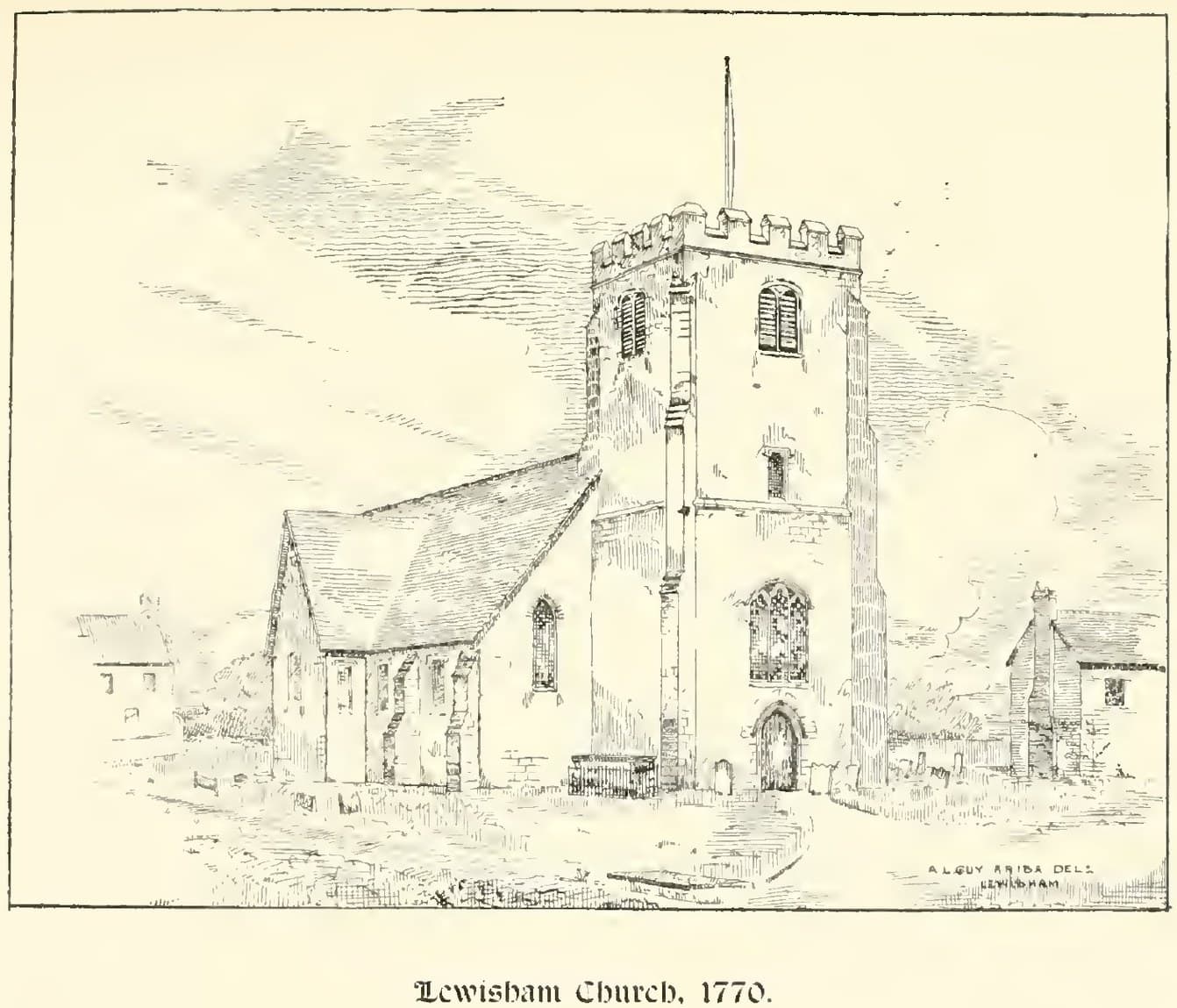
The church that stands here is Georgian, and the history of it is mostly a history of building work. Underneath that is a much longer period when this was a different kind of place: lamps burning day and night before painted images, two priests employed to sing for the souls of named dead people, guilds that paid sick money to their members, and a great crucifix on a beam across the chancel arch.
All of it was taken apart within about fifteen years, by statute. What follows survives because Leland Duncan went through the wills proved in the church courts at Rochester and Canterbury and copied out every bequest to Lewisham church he could find. So this is a picture of a parish assembled from a few hundred deathbeds.
Lights and images
There were at least two images of the Blessed Virgin — one in the high chancel, one in the body of the church — and lamps burned before them, kept going by small gifts from parishioners. In 1473 Cecily Lamkyn of Perry Street left eightpence towards painting the image of the Virgin. In 1476 John Gwyn left twelvepence towards painting the one beside the high altar.
The lights were intensely local. Our Lady’s light stood on a pillar on the south side of the nave, and people left money to the one nearest their own seat: in 1514 John Kichell left twelvepence to our Lady light on the pilour at my sete end, and in 1524 Thomas Johnson left fourpence to the light in front of his pew. Richard Batt of Sippenham left half a pound of wax in 1512, to be found perpetually by his heirs, to bren on the Sondaies and festival daies.
Over the entrance to the chancel hung the rood, with its own light — called the light of the Holy Cross, or the beam light, or simply the Rood Light, depending on who was writing. In the Trinity chapel there was a light of the Holy Trinity and an image of St John the Baptist, before which Robert Cheseman asked in 1498 to be buried, leaving money for two Tapers of wax to bren before the image of Saynt Baptiste.
And for a while there was a light here in memory of King Henry VI. It is mentioned just once, in Thomas Johnson’s will of 1524 — but people across England had begun treating that deposed and murdered king as a saint, without any authority ever saying he was one, and for a few years somebody in Lewisham was paying for a candle to burn for him.
Under Edward VI the lights before images were all put out. The injunctions allowed two to remain, on the high altar before the Sacrament, and in time even those went. Candles were not lit on the altar here again until 1882.
The chantries
A chantry was an endowment to pay a priest to sing mass for named souls, in perpetuity. Lewisham had two, both at the altar of the Holy Trinity. That altar stood in the south chancel, which in J. A. B. Robertson’s account corresponds to what is now the Hough Chapel — named after a twentieth-century vicar of this parish who became Bishop of Woolwich. Two priests were paid to sing there for the dead in perpetuity; perpetuity lasted about fifty years.
Richard Walker, a citizen and grocer of London born at Bingley in Yorkshire and living in this parish, founded the first by his will of 11 November 1494. He set out the arrangements in unusual detail: a priest of honest and good conu’sacon to sing daily — the mass of the Angels on Mondays, of the Holy Trinity on Wednesdays, of Our Lady on Saturdays — beginning between seven and eight in the morning. Twice a week he was to say the office of the dead for Walker and his wife. Every year on the anniversary of his death there was to be a service with the psalms overnight and a requiem in the morning, and at it, Walker’s will was to be read aloud to the parishioners.
He also left the vicar two shillings and eightpence a year, paid quarterly, so that every Sunday from the pulpit his soul and his wife’s should be commended to the prayers of the people. The money left over went into a chest under two locks, one key held by the parish and one by his executors. And he left five marks towards building the steeple.
The second was founded by Roger Fitz in 1504, of a family whose house stood at Rushey Green. He asked to be buried before the middle of the Trinity altar under a plain stone, and directed that two properties he owned — the Lyon and the Ram, in the stews of Southwark — be sold to endow a priest. They were not sold; both were still family property a century later, and no chantry of his appears in the records. Whatever he intended, it did not happen.
When the chantries were suppressed under Edward VI, the priest serving Walker’s foundation was Myles North, aged 58, of whom the certificate notes only that he hath to lyve on besides the said chauntrie. The same certificate records that the chantry had kept no grammar school, maintained no preacher and relieved no poor people, and that of goods there — none.
The guilds
Two fraternities were attached to this church: the Brotherhood of the Holy Trinity, the older and larger, and the Brotherhood of Our Lady and Saint George, first heard of in 1527.
They were devotional societies and they were also something like friendly societies. Men and women joined, bound themselves to attend the meetings and the funerals of members, and paid a subscription — and the fund went to the relief of members out of work through no misbehaviour of their own, or too old or too ill to earn a living. They also kept the light burning before their patron saint.
The gifts to them show what parishioners actually had to give:
- 1471William SpriggA cow
- 1476John Gwyn6s 8d, for making his grave in the Trinity chapel
- 1476Christian Sprigg, widow3s 4d towards the upkeep of the fraternity
- 1509John SmythA bullock, price 4s
- 1511John A Wynne3s 4d
- 1514Thomas Rede“I will the Trenyte gilde in Leuysham have a stare of on yere age” — a yearling steer
- 1527Richard Edwardes40s to the brotherhood of Our Lady and Saint George
- 1528John Berepikyll, husbandman12d to the same
The name of the second guild may survive in a pub. What is now Zion House was called The George as far back as Elizabeth’s reign, and stood close enough to the church that Duncan thought it might have been where the brotherhood met.
Both were swept away with the chantries. Neither had any land, so there was nothing much to seize; they simply stop being mentioned.
What people gave
Parishioners fitted the church out. In 1521 Stephen Colman left the residue of his goods towards buying a payre of organys — unless the churchwardens thought of something better — and a pair of organs duly appears in the inventory thirty years later. William Sprigg, who Duncan calls the munificent founder of the tower works, left money in 1471 for a service book worth twelve marks to stay in the choir before the vicar for ever. There were banners, a canopy with four staves, altar cloths, a gold ring towards making a pyx.
The most striking bequest is Isabella Fleming’s. Widow of the Roger Fitz who had tried to endow a chantry, she left the church in 1544 her kirtle of crimson satin, to be made into a vestment, and directed that an altar cloth for the high altar be made out of her damask jacket of white and green. Her clothes were to go on being worn in the building after her.
Duncan noticed something in that. Bequests like hers, he wrote, help explain why church inventories of the period list cloths and vestments in colours the rules never authorised. The parish wore what it was given.
The stripping
By 1552, when the commissioners came round to inventory church goods across the Hundred of Blackheath, Lewisham was — in Duncan’s words — very rich in both plate and vestments, all of it accumulated by exactly the gifts above. The inventory was taken on 16 November that year, and what is left of the parish’s silver is on the church silver page.
Within a generation the chantries were dissolved, the guilds gone, the lights out, the images taken down and the rood removed. The building stayed; almost everything that had been done inside it stopped. It is worth standing in the church and knowing that the plainness is not original — it was arrived at, deliberately, and quite fast.
Somebody drew it from the wills
Everything on this page comes from bequests, and in the 1930s a Blackheath historian called Alan Roger Martin did the obvious thing with them and the hard thing: he read the wills for what they said about where people wanted their candles and their masses, and reconstructed the plan of the vanished church from the answers.
His drawing gives the medieval building a shape. A Chapel of the Virgin of about 1500 on the north side. A Trinity Chapel and Vicar’s Chancel of 1463, beside the high chancel. An Early English lancet surviving at the west end of the nave, late Perpendicular work at the east. A great stone pillar in the middle of it, and the pulpit against the north wall. The tower going up from 1471 to 1512, with its stair added at the end — which is what the tower bequests record from the other side.
Martin is the same man who wrote The Alien Priory of Lewisham in 1927. His notes for the reconstruction were handwritten, and were turned into text by Julian Watson, whose work the whole of this section rests on.
The plan itself is not reproduced here. It reached this site through the heritage exhibition Julian Watson prepared in 2018, for which permissions were given by the Lewisham archivist for a printed exhibition and a lecture — and those permissions do not extend to a website. It would have to be asked for again.
Elsewhere on this site
The parish in this period belonged to an abbey in Flanders — the Ghent connection, which also has the story of the woman who took sanctuary in this church in 1254. The tower that Sprigg and Walker were leaving money towards is on the tower and the bells, and the men who served the altars are on the vicars of Lewisham. The other thing in this parish dedicated to Our Lady is a well a few minutes’ walk away, which named the neighbourhood and is now under the road — Ladywell, and the well.
Where this comes from
This parish is fortunate in its historians. Three works stand behind these pages, and none of them is ours.
St Mary's Church Lewisham: History (2004, revised 2017)
Julian Watson
Copyright Julian Watson, used with his permission. The greater part of what is written here comes from this book and from his unpublished research, and any of it that is wrong is our doing rather than his.
The Churchyard of St Mary the Virgin, Lewisham (1992)
Ken White
Copyright Ken White, used with his permission.
The Church Record of St Mary the Virgin, Lewisham
The Arts Society Blackheath and The Arts Society Greenwich, completed by the Church Recording Society, 2021–2024
A catalogue of every object in the building, begun in the incumbency of Canon David Garlick and finished in that of Fr Steve Hall. The descriptions, measurements and attributions of the monuments come from it.
The Parish Church of Saint Mary, Lewisham, Kent (1892)
Leland L. Duncan, F.S.A.
Out of copyright, so this is a citation rather than a licence — but it is the single largest source for the medieval parish, the tower bequests, the churchyard, the vicarage house and the medieval vicars, and its six plates are the earliest images the parish has. Duncan was honorary secretary of the Lewisham Antiquarian Society, which met in the parish church hall, and he was educated at Colfe's — the school one of these vicars founded.
Some of these captions are guesses. Please correct us.
The parish archive runs to well over a thousand photographs, most of them unlabelled. Where a caption here rests on a filename rather than on a document, it says so — but we will have got things wrong that we do not yet know are wrong.
If you recognise a place, a face, a date or an object, we would be very glad to hear from you, and we will change the page and say who told us. Photographs of the church before the 1990s re-ordering, and anything at all of the choir, would be especially welcome.
Text and images are the copyright of their authors unless otherwise stated. If you would like to reproduce anything from these pages, please ask us and we will put you in touch with the right person.