History & Heritage
The church silver
A flagon from the Civil War, an alms dish probably designed by Pugin, and a piece of Russian Orthodox silver that nobody can explain.
The parish plate is on loan to the Victoria and Albert Museum and is not kept in the church, so it cannot be seen here. It can be seen there, which is a better outcome than most parishes manage for silver of this quality — and it is on show rather than in a store. The Orthodox dish and the Pugin alms dish are both in the Sacred Silver and Stained Glass galleries, room 83. Each is catalogued as lent by this parish.
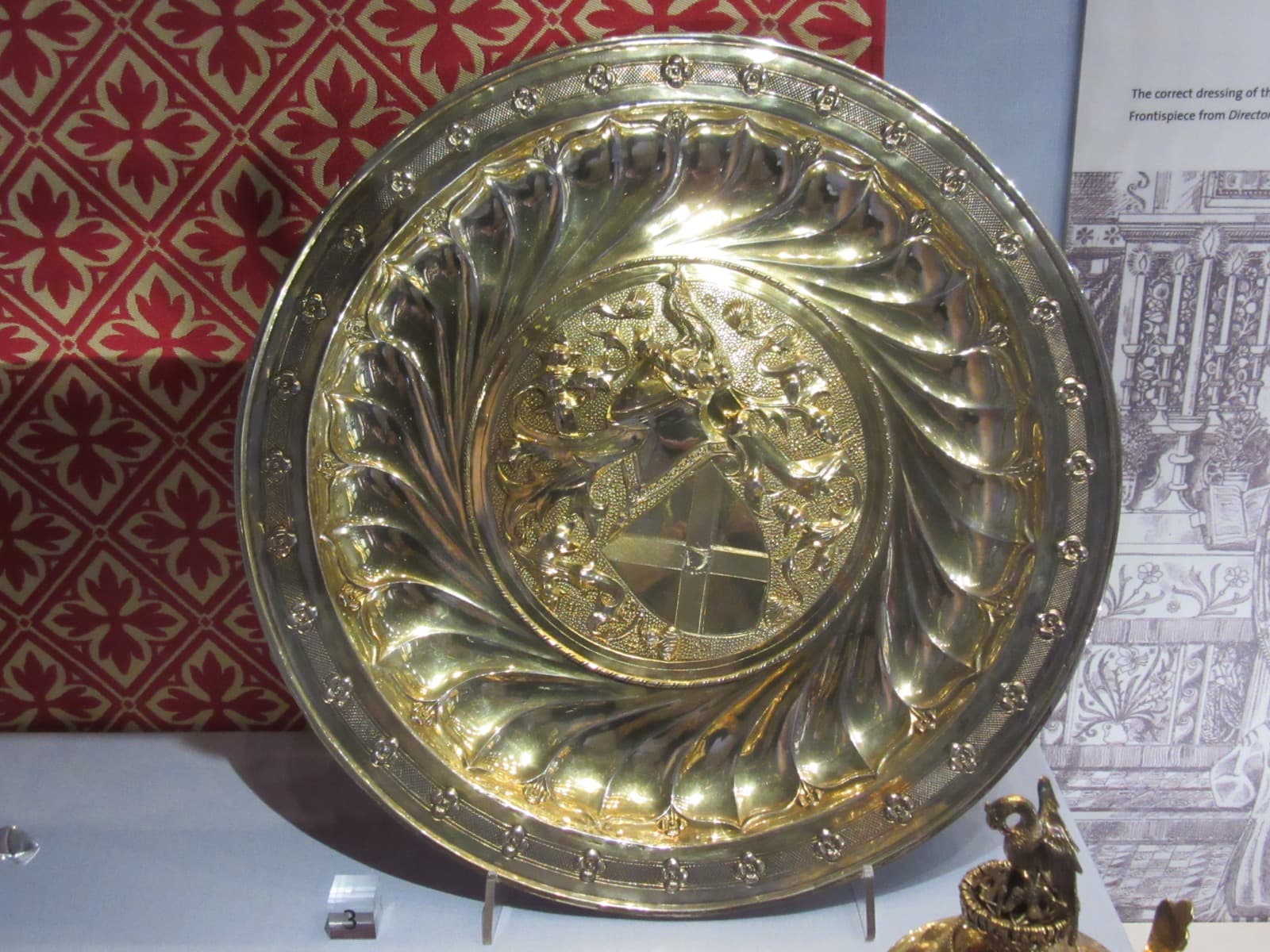
The strangest piece
A dish made in Moscow in 1688 or 1689 for use in the Orthodox liturgy, engraved at the centre with Christ between two angels and lettered in Old Church Slavonic — the liturgical language of the Russian church. It has been part of the plate of an English parish church for long enough that nobody now knows how it arrived.
There is no record of a donor, no inscription tying it to Lewisham, and no story attached to it. It is simply here, among the communion silver of a church on the Kentish border, three thousand miles from where it was made.
Even what is on it is not settled. The museum’s own record describes the centre twice and differently: in one field as Christ the sacrificial victim between two angels, in another as an allegorical scene of the Baptism of Christ. The first is the reading given to visitors and it is the one used above. Both are the V&A’s, and we have not seen the dish to judge between them.
The whole plate
Dish for the Orthodox liturgy
Moscow, 1688–9
Silver, parcel-gilt. Used in Russian Orthodox worship to hold the consecrated bread, its centre engraved with Christ as the sacrificial victim between two angels, the inscriptions in Old Church Slavonic. How a piece of Muscovite liturgical silver reached a parish church in Kent is not recorded.
Flagon
English, 1646
Inscribed “Given to the Parish Church of Lewisham at Easter A.D. 1686”. Made during the Civil War and given forty years later.
Communion cup
English, 1684
Carrying the same 1686 inscription as the flagon — the two were evidently given together, by someone whose name has not survived with them.
Alms dish
English, 1685
The older of the two alms dishes.
Alms dish in the Gothic style
1864–5
Silver-gilt, made in Birmingham by John Hardman and Co and probably designed by A.W.N. Pugin — the architect of the Palace of Westminster interiors — though made a dozen years after his death. It recalls the brass dishes exported from Nuremberg in the sixteenth century. It was not made for this church: the museum believes Pugin designed it for Henry Drummond of Albury Park in Surrey, and the Drummond crest is still embossed in the bowl, holding a shield engraved with the arms of the diocese of Rochester. Lewisham acquired it in 1885, when this parish still belonged to that diocese.
Baptismal bowl
London, 1735
Inscribed “The gift of Thos. Hawtree of Deptford to the parish of Lewisham in Kent 1735”.
Standing paten
English, 1718
Strainer spoon
English, c.1723
Communion cup
English, 1806
Inscribed “Lewisham Church A.D. 1806”.
Knife
London, 1833
What was nearly lost
When the church burned on the day after Christmas 1830, the report in The Morning Chronicle noted, almost as an afterthought, that “a part of the Communion plate has been saved”. The building was not insured. Whatever was carried out of a burning church that morning is a good deal of what is now in South Kensington.
Elsewhere on this site
The 1552 inventory that found this parish very rich in both plate and vestments is the end of the story told on the medieval parish: every piece of it had arrived as a deathbed gift, and the commissioners came for the lot. The arms on the Pugin alms dish are those of Rochester, the diocese this parish belonged to under an arrangement that began with a Flemish abbey — the Ghent connection.
The fire on the day after Christmas 1830 took a great deal more than it left. The parish’s registers and papers burned in the vestry the same morning, which is why the list of vicars has a gap of nearly two centuries in its churchwardens and the vicarage cannot be placed on the ground before 1692 — though a terrier of 1634 survives elsewhere and describes it room by room. The gallery the fire damaged, and the monument in it that may have been harmed by it, are on the monuments.
This is not the only thing of the parish’s in South Kensington. A knife and fork of about 1698 in the same museum carry a cutler’s mark that is probably Ephraim How’s, whose works stood at Southend in this parish; he is on the monuments too.
Where this comes from
This parish is fortunate in its historians. Three works stand behind these pages, and none of them is ours.
St Mary's Church Lewisham: History (2004, revised 2017)
Julian Watson
Copyright Julian Watson, used with his permission. The greater part of what is written here comes from this book and from his unpublished research, and any of it that is wrong is our doing rather than his.
The Churchyard of St Mary the Virgin, Lewisham (1992)
Ken White
Copyright Ken White, used with his permission.
The Church Record of St Mary the Virgin, Lewisham
The Arts Society Blackheath and The Arts Society Greenwich, completed by the Church Recording Society, 2021–2024
A catalogue of every object in the building, begun in the incumbency of Canon David Garlick and finished in that of Fr Steve Hall. The descriptions, measurements and attributions of the monuments come from it.
The Parish Church of Saint Mary, Lewisham, Kent (1892)
Leland L. Duncan, F.S.A.
Out of copyright, so this is a citation rather than a licence — but it is the single largest source for the medieval parish, the tower bequests, the churchyard, the vicarage house and the medieval vicars, and its six plates are the earliest images the parish has. Duncan was honorary secretary of the Lewisham Antiquarian Society, which met in the parish church hall, and he was educated at Colfe's — the school one of these vicars founded.
Some of these captions are guesses. Please correct us.
The parish archive runs to well over a thousand photographs, most of them unlabelled. Where a caption here rests on a filename rather than on a document, it says so — but we will have got things wrong that we do not yet know are wrong.
If you recognise a place, a face, a date or an object, we would be very glad to hear from you, and we will change the page and say who told us. Photographs of the church before the 1990s re-ordering, and anything at all of the choir, would be especially welcome.
Text and images are the copyright of their authors unless otherwise stated. If you would like to reproduce anything from these pages, please ask us and we will put you in touch with the right person.