History & Heritage
Ladywell, and the well
The place is named after a well dedicated to Our Lady. It is under the road now, and its link to this church is old, likely, and unproven.
Where it was
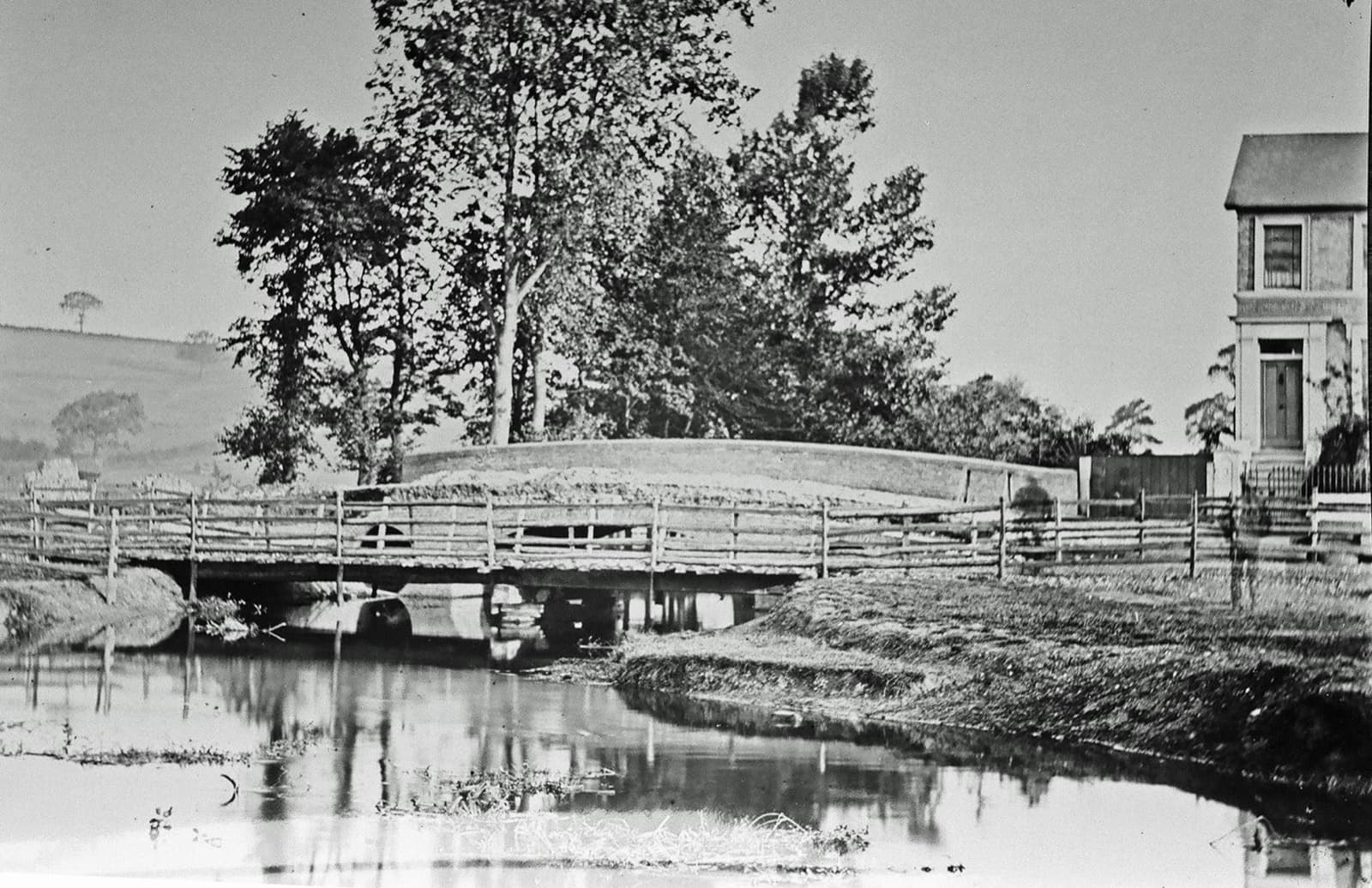
The site is hard to fix precisely, because it is no longer visible. It lay under what is now Ladywell Bridge, close to the junction of Railway Terrace and Ladywell Road — which is to say more or less in the middle of the road, a few minutes’ walk from the church.
Henry Warren drew it in 1827, with St Mary’s just visible through the trees on the right. Warren recorded that “many resort here to drink the waters, the properties of which resemble those of Cheltenham”. His own picture is less reverent about it: a woman is filling a vessel for the house and a gardener is filling a wooden bucket and a watering can.
What is actually known
A well dedicated to Our Lady, which gave its name to the neighbourhood. Still in use as a spring in the early nineteenth century, and thought of then as medicinal rather than holy. Built over when the bridge was rebuilt — a new stone bridge was begun in 1830.
That is close to all of it.
What is believed, and not established
That the church stands where it does because of the well. This is said often in Lewisham, and it is a perfectly reasonable thing to think: holy wells and early churches do go together, the two are a few hundred yards apart, and the dedication of the well is to the same Lady as the dedication of the church.
But the parish’s own historians do not claim it as fact, and neither will we. There is no document connecting them. The earliest reference to churches in Lewisham is a charter of 964, and it does not say where they were.
We say “close to, and almost certainly linked with” because that is as far as the evidence goes. If anything firmer ever turns up, this page will be glad to change.
Underground
Members of the Kent Underground Research Group have been into the culverts and drains beneath that part of Ladywell with the parish, in the hope of establishing what survives of the well below the modern road surface. The archive holds photographs from those visits.
Getting there
Ladywell station is a few minutes from the church, and the walk between them goes past the spot — see visiting us. There is nothing to see, which is worth knowing before you go looking for it.
Elsewhere on this site
The well was dedicated to Our Lady, and so is the church. Before the Reformation there were at least two images of the Virgin in the building with lamps kept burning in front of them by parishioners, who left money to the light nearest their own seat — all of it put out under Edward VI, on the medieval parish. An image of Our Lady came back in December 2025, and the iconographer painted this well into it: a gold ring around a cross with four springs of water, worked into the cover of the book in the Christ Child’s hand. That is on Our Lady of Lewisham.
The charter of 964 that gives the earliest reference to churches here is one of two dates the parish has never reconciled — the other being the grant of 918 that the millenary was kept from. Why neither is certain is set out on the Ghent connection.
Where this comes from
This parish is fortunate in its historians. Three works stand behind these pages, and none of them is ours.
St Mary's Church Lewisham: History (2004, revised 2017)
Julian Watson
Copyright Julian Watson, used with his permission. The greater part of what is written here comes from this book and from his unpublished research, and any of it that is wrong is our doing rather than his.
The Churchyard of St Mary the Virgin, Lewisham (1992)
Ken White
Copyright Ken White, used with his permission.
The Church Record of St Mary the Virgin, Lewisham
The Arts Society Blackheath and The Arts Society Greenwich, completed by the Church Recording Society, 2021–2024
A catalogue of every object in the building, begun in the incumbency of Canon David Garlick and finished in that of Fr Steve Hall. The descriptions, measurements and attributions of the monuments come from it.
The Parish Church of Saint Mary, Lewisham, Kent (1892)
Leland L. Duncan, F.S.A.
Out of copyright, so this is a citation rather than a licence — but it is the single largest source for the medieval parish, the tower bequests, the churchyard, the vicarage house and the medieval vicars, and its six plates are the earliest images the parish has. Duncan was honorary secretary of the Lewisham Antiquarian Society, which met in the parish church hall, and he was educated at Colfe's — the school one of these vicars founded.
Henry Warren’s lithograph of the well, 1827, is reproduced in Julian Watson’s history.
Some of these captions are guesses. Please correct us.
The parish archive runs to well over a thousand photographs, most of them unlabelled. Where a caption here rests on a filename rather than on a document, it says so — but we will have got things wrong that we do not yet know are wrong.
If you recognise a place, a face, a date or an object, we would be very glad to hear from you, and we will change the page and say who told us. Photographs of the church before the 1990s re-ordering, and anything at all of the choir, would be especially welcome.
Text and images are the copyright of their authors unless otherwise stated. If you would like to reproduce anything from these pages, please ask us and we will put you in touch with the right person.